Showing posts with label Castle. Show all posts

Thursday, November 10, 2011

Day 96. Nimes. Nov 10 2001.

The Day Of Bitter Winds.

A day of excitement, beauty and brutality so great it has shaken our faith in humanity.

The deathly winds of the Mistral clutched Nimes in icy talons, tearing at branches and shutters until the whole hillside howled in protest. We retraced our journey into the city slowly and explored the Jardin De La Fountaine with excited awe. The god Nemausus had raised a bubbling spring here and the Egyptian veterans of the Battle of Actium found welcome refuge beside his cool waters. The gardens were built over a series of canals that channeled water to the city, deep watery grooves in the earth.


Behind rose a veritable mountain of stairs topped by infinite greenery that hid the sloping hill from sight.

 
An ancient temple's ruins rose in a shadowed niche, crumbling ruins to an unknown god trapping the crescent moon of the morning between decaying stones.


We climbed the stairs to the shelter of trees and the howling of wind dropped to a quiet susurration of leaves, the sun beat down with no wind to cool it. We climbed crumbled stones paths until we slipped from the shadow of trees to the shadow of Nimes Great Tower. The tower of Roman Nimes rose from the highest of seven hills, a warning to would be conquerors and a beacon marking the gushing waters below. The tower rose 30 meters above us on the top of the hill, a white shard of antiquity gleaming almost painfully in the sun.


We climbed it’s two thousand and sixteen year old interior and looked out on a view that spanned all of Nimes and the country around it, gasping for breath in the heights. The towers innards were gone and our rarefied perch rested on a stairway built after an obscure Frenchman gutted the interior searching for a treasure prophesied by Nostradamus.

We returned to earth and the pleasure of the garden, walking a double spiral of labyrinthine hedges in delight. We hurried to the coliseum that we had seen the night before and we admired its grandiose arches the bespoke ancient power. But it was closed today for the Corrida and we bought tickets, excitedly eager to see a cultural event renown for its beauty. Then we retraced our steps through the town, back into the mazelike streets of the city’s market district, everything stamped with the city emblem of crocodile and palm tree.

Then we found the temple. The Square House of Nimes, One thousand nine hundred and ninety eight years old. Perfect Corinthian columns supporting ancient roofing tiles raised to cover a sanctuary of the Imperial Cult. The temple was magnificent. The wind whistled between the fluted columns and bit deep beneath our layers of clothes.


Our final sightseeing stop was the Castellum, the distribution tank of the in rushing water from the ancient aqueduct which ran over the Pont Du Gard. The pipes sending water throughout the ancient Roman city were still visible and although it was mostly a pit in the ground it was still a practical working part of Roman life. That more than temple or coliseum or ancient towers brought the dead to life for me.


We returned through the tiny medieval streets, a thousand colorful storefronts opening their doors and spilling their wares out into the cobblestone paths invitingly. The wind howled overhead, angry at the protection afforded mortals by the canyons of stone. We gave in to the cold and the invitations of the street merchants and bought gloves for our frozen hands. Then to the Arena for the Corrida.

It was exciting to line up with the rest and know that the arena was being used for something approaching it’s original purpose. Our hearts raced as the adrenaline surge of the crowd rushed over us. People waved happily to one another while the band played and vendors danced along the ancient roman railings, tossing peanuts and chips to the crowd and deftly catching coins tossed their way. The intensity built as we waited until the stones seemed to throb with impatience. The doors opened and the players walked to the sands. There were the matadors, their assistants, men in armor on armored and blindfolded horses and wagoneers with heavy horses and chains. They filed off the sand and took refuge in the wings and waited for the bullfight to begin. The music blared and it started.

The spectacle began in beauty. The expanse of sands, a long blast of familiar music and the powerful fury of the charging bull taking to the arena. The swirling flowers of color made as the man danced around the deadly thrust of horn or the heavily muscled bulk of head and neck. The soft, indrawn whisper of Ole as the beast surged majestically around the man.

Then the slaughter began.

The poetry of the corrida tells of the meeting between man and beast. It tells of the struggle between mind and muscle and the beauty of the dance of death.

The poetry of the corrida is a diseased lie told by those who gorge themselves on feasts of blood and agony. The songs that are sung say nothing of torture and torment, of enraging an innocent beast over and over again, so he is driven to a froth of exhaustion, nothing of spears thrust into writhing muscles and tender flesh to destroy the strength of a bewildered animal. Those who praise the arena and the masculine strength of the matador speak only softly of the darts flung into the back of a beast who cannot understand what is happening. Barbs of pain to snap a mind already at its bestial limits with terror, barbs that drain strength in spasms of frantic energy as the beast tries to free itself from agony. And nothing is ever said of a beast too exhausted to move, to stand, collapsing in a pathetic mewling heap on sand stained with its own blood, while the savage crowd boos the poor sport. Not even in whispers is it told of the shame of desperate matadors, trying to drag their ravaged prey to its feet with angry tugs on it’s tail, until they are almost dragging the beast around the sands by its ass. Advocates of blood sport don’t discuss the confusion and terror on the face of a dying bull, understandable even across the gap of species that separates us. They speak not of torment and torture. They say the matador faces a dying bull alone, ignoring the men who distract it with fluttering capes because the matador is too frightened of the savage mess of blood and agony he has created. They don't speak of a beast so wounded that it is vomiting, pissing and shitting blood across the sand. And no one ever, ever, talks about the bull falling to its side and a terrified little man thrusting a dagger deep into its skull and pureeing its brains while it spasms across the sand in it’s death throes.


We rose and left after the second bull, unable to bear the shame of being human any longer. My awe for the beauty of the stadium dissolving in a rush of disgust and humiliation that my species should be the perpetrators of such sadistic crimes. That crowds should cheer it!

A guard sneered as we left and proclaimed that “There is always one that can’t take it.” He cannot know that my heart pleads that such should be the case, that somewhere people know shame.

Next Entry: Day 97. Nimes
Previous Entry: Day 95. Nimes

Tuesday, October 11, 2011

Day 66. Le Meillerage-De-Bretagne. Oct 11 2001.

Fog and Spiders Part II.

We woke this morning to a fog as thick as yesterdays. But today we couldn't roll over in our sleeping bags and sleep or sit up and watch the intricate patterns. Today we had to pack our soggy things and carry on with the trip. Everything was wet and had begun to acquire that wonderful smell of moldy bread and we have little left in the way of clean socks and underwear. Not ones to be daunted we rose early, I cannot say bright because the sun was hidden, stuffed our soggy things into our wet bags and climbed out of our little vale towards the main roads.

Breathing was like drinking and before we had gone very far we were drenched to the skin and all our hair, along with any fuzz on our clothes, was coated in a thick pattern of white beads that made us look hoary and grey. We passed out from the village over the dam that held back the reservoir and to our right a rocky little stream bubbled down over the stones and fallen logs to disappear mysteriously into the mists. Looking down on it was like looking through a magic mirror into an enchanted land and we forgot, for the moment, our sopping bodies.

Biking in a mist as thick as today’s was an interesting challenge for we could not see more than a hundred feet in front of us. Trucks appeared out of the mists like magically summoned beasts or the ancient ones of lovecraftian stories, leaving behind their roar and swirling clouds as they disappeared once more. Trees appeared like leering specters on the edge of our vision and houses sat silent as though deserted. Used to mists at home, that scarcely last past midmorning, we waited for the sun to emerge and burn off the fog. We waited and we waited and we waited.

We also passed some very interesting signs on the road.

image004


Today we had planned on a big push towards Nantes to avoid staying at a closed campground. But we had not reckoned for roadwork. The road we should have taken to Chateaubriant was closed for construction and we were forced to take a very long detour. Long at least for those on bikes, it was perhaps twenty minutes to half and hour out of the way for someone in a car.

At the intersection where we would have turned off the French tourist board had erected a replica Neolithic monument amidst a circular garden.

image005

It was very eerie to have watched such a monument loom at you out of the mists, no matter how contemporary it was.

I wonder if genuine ones really marked a road of power for the ancients, if they did in fact follow ley lines of mystic energy or were only solitary isolated attempt to mark, in a human way, the feeling of the numinous. Perhaps in much the same way as Cathedrals and spires do.

Again today the spiders were out in full force, eventually growing to numbers that put yesterday to shame. They dropped from the tress and spun webs between vast distances, linking lamp posts and telephone poles and road signs in one vast cobweb. Even we, who were constantly on the move, became hosts for spider webs, eventually trailing them like streamers in long lines behind us. Occasionally a cluster of webs would break from their moorings and float along an imperceptible breeze, riding currents over furrows in the fields like dragons over mountaintops.

We followed the detour signs away from our destination, Chateaubriant getting more and more distant with very turn of the pedal. I grew first concerned, then worried and finally mad that we had to move so far from our path. Ironically enough the road which we now followed led straight to Angers.

Finally, after a brief consultation with the map, we took the next turn south, despite the sign warning “no through traffic.” Now we entered a dark and gloomy forest that sheltered us, for the moment, from the mists. At last we could see ahead. It was like pulling off a blindfold. Soon we left the forest, reentering the mists and eventually hooking up with a westward road that would take us straight to Chateaubriant. It seems the road detour went all the way to Angers despite the fact that you could shorten the distance the way we did. Perhaps the locals didn’t want the traffic.

Now at last the mist began to dissipate and we were treated to a wonderful blue sky and no wind to speak of. It was enchanting to watch the mist lift off the fields in long columns of vapor but a little strange to watch it happen an hour after noon. Just on the outskirts of Chateaubriant we saw a monument peering through the trees and through we might break for lunch there.

It was a large patriotic monument dedicated to 27 locals who had been executed by Nazi’s. 27 pillars with portraits of the dead ringed a square while at the front were wooden posts like those they were tied to before being executed behind them and looming over all was a stone carving of the men dying at the post.


image006


Beneath were glass canisters in a wall with earth from every place important to the French resistance. Overwhelming it all was a spirit of “Never Again” But I was forced to ask myself, never what again? Never again should people be executed? But hundreds are executed around the world every year, many of them in the US and few protest. Never again should people die for their beliefs? What about Waco or the followers of Falun Gong? Never again should people be under the rule of a people like the Nazis? But the Taliban forced Hindus and Jews to wear yellow badges’ setting them apart and nothing was done ecept a little posturing. The war in Afghanistan has nothing to do with the Nazi-esque behaviors of the Taliban. So the question remains “Never Again” what? Does "Never Again" only apply to stable westernized democracies and even then those with a sufficiently large nuclear arsenal are left alone?


We left there without eating and entered the town of Chateaubriant and decided to take our lunch in the courtyard of their beautiful castle.
image007
image008

Here a man approached Heather, shouting angrily in French that there was no eating allowing in the yard, despite picnic benches and garbage cans everywhere. When she did not understand he became exasperated and his lady companion translated in disgust. As we left we were glared at from every corner. We would have liked to explore the castle and look at the theater next to it but we left in disgust instead. The theater across the street from the castle was a small cube, supported inside by four pillars. The outside was entirely of transparent glass and it was called La Theatre en Verre, the Theater of Glass. Very intriguing.

We headed south once more and once more were wrapped in cocoons of spider silk. Eventually we became too exhausted to go much further and in spite of being far short of our goal we began to look for campground signs eagerly. We found one at a small town and occupied its municipal grounds with vigor, despite the locked washrooms. At least the water was running. I have discovered something about France. The smaller the town the larger the name. Paris, Nantes, Avignon, Bordeaux. One or two, even three syllables. The name of this town, the one before, tiny places, long names. Inferiority complex perhaps?

Here too we were reintroduced to the sound of church bells, unheard since Mont St. Michel, every hour and half hour. But after six o’clock the ringers began making mistakes, ringing four times or fifteen and, after a mistake, they would ring the bells like crazy as if to cover their error with a cacophony of noise. Enchanting as bells can be, after three mistakes we were ready to blow up the church. Perhaps explaining many religious wars in the process.

This campground was very isolated and the youths who dropped by to check us out from time to time did little to sooth my jumpy nerves. We kept looking in askance in the direction of the town, made very tense by the constant loud shouting and violent barking of dogs. We felt sheepish on peering over the bushes and watching a man try desperately to teach his dog to fetch a stick. Stupid dog! Still the constantly falling acorns made strange noises in the dark and I did not sleep particularly well.


Next Entry: Day 67. Nort Sur Erdre
Previous Entry: Day 65. Marcille Robert

Sunday, October 09, 2011

Day 64. Marcille-Robert. Oct 9 2001.

Now that we are heading south once more a new challenge, separate from the weather, arises before us. No longer can we assume that campgrounds will present themselves before our weary eyes. Instead we have to plan our route to take us to the scattered few places that remain open into the beginning months of winter. The further we travel, the greater this difficulty will become. So today, instead of traveling south to our next destination town of Nantes, we were forced instead to do a southeastern jaunt across country.


We woke up late and took a long time to pack up. We are like water when we stop, filling up every nook and cranny and spreading out until we encounter an obstacle. We biked across the city, discovering that it spreads out far further south than we had realized. At home we judge the size of a city by the height of it’s skyline. The higher and more numerous the buildings, the bigger we expect the city to be. Here that system does not serve us well. Skylines tend to be low to the ground, no more than five stories, but cities sprawls across a great area.

The trip out of town was mostly pleasant and the weather was cooperative, giving us blue skies to bike under. Heather’s bike, however, was less cooperative and by the time we reached the town of Chateau Giron she had to stop and fix her panniers yet again. It was fine however, as it gave me a chance to explore the castle from which the town derived its name.

image003

The castle was an intricate structure made up from towers and churches and residential blocks and none of it was open to the public. The towers and the chapel were sealed off completely while the central residence played host to the administration of the city. A residential bloc projecting westward off the castle provided tenement housing. Actually that’s just conjecture on my part. It may have been more administration, if stacks of mailboxes means administration and the city workers like to pee in the stairwells. There seems to be a very laissez faire attitude towards urination in France.

The castle was, however, very beautiful, towering above a tiny town that was coated in a blanket of flowers. There was an ancient mill nearby and a long park leading into the town. After a brief walk around the castle Heather had her bike back in riding fashion and off we went again.

The rest of the trip was, fortunately enough, mostly uneventful. The countryside we were passing through was interesting though, for here had passed the adventures of Asterix and his menhir delivering friend Obelix. We looked for menhirs but none immediately presented themselves.

Finally we arrived, or thought we did, at our destination. We followed the signs that said “Camping” happily. But when we hit a T intersection, the signs disapeared. I wanted to go left but Heather needed to go right, to go into town and get some groceries. Lo and behold, there in town were the signs for camping once more. Which just goes to show you, put food before path finding.

The campground was very nice but our initial moments were very frustrating. We had gone out of our way to ensure that we had an open campground in which to spend the night. But we discovered to our horror that the warden’s hut was closed and the bathrooms firmly shuttered. I was…well, the word livid comes to mind. But we soon found out that the handicapped stall of the washroom was open and we settled in for the night. It turned out later that the warden only comes around as dusk and opens the washrooms if there is anyone to use them, but how was I supposed to know?

The campground was a series of terraces going down a hillside to the edge of a lake. We had a beautiful view. The lake extended north and south beyond the limits of vision and was overhung with trees. On the far bank was an ancient stone wall with mossy stairs leading down to the water, a thoroughly enchanting setting. We sat down on the lakeshore to enjoy our dinner and to read a little of the Hobbit.

Here Heather’s unique charm worked its magic once more and an elderly gentleman crossed the grass and began to relate his life story. He and his wife were vacationing from the channel island of Guernsey and he was delighted to discover we spoke English. When he found out what we were having for dinner, sandwiches, he was horrified and insisted that we join his party for dinner. I would have demurred but Heather was excited to be included in a social atmosphere again and agreed. I think that Heather is missing social interaction more than I am and she is feeling pretty isolated with her limited command of the French language.

So, we dolled ourselves up in our best outfits, which is to say that we tried to find something not sweet stained, and we cleaned ourselves up as best as we could mange. We headed over to their small camper van and had dinner. It was almost a strange sensation to be surrounded by four unmoving walls and to be eating at a table with a roof over our heads. If the small amenities of civilization are so alien to us now, after only a few weeks, what savages will we be when we return?

Dinner was steak, a sausage and shrimp with wine and cheese and Brian and Margaret proved to be most gracious hosts. Margaret had been a yoga instructor in her prime and Brian made violins in his retirement. We both nodded appreciatively when he pulled out his latest creation and handed it to us for inspection, like we know anything about violins. Heather was very keen to discuss yoga with Margaret as we were trying to learn some on this trip. But learning from a book is never the same as from a real person and we could have used a few pointers. Brian, however, turned out to be the vocal one and if Margaret said more than twenty words the entire night I would have been surprised. Included with dinner were local mushrooms that Brian had picked himself. We aren’t dead so they must have been alright, proving that you can live off the land. Perhaps if we fall to raiding farmer’s fields and a little old fashioned cattle rustling we can stay in France indefinitely.


Next Entry: Day 65. Marcille Robert
Previous Entry: Day 63. Rennes

Wednesday, October 05, 2011

Day 60. Le Mont St. Michel. Oct 5 2001.

We arrived today with tide still in and what a difference it made. From a rock, albeit a beautiful rock, sitting in gray mud, The Mont was transformed into an island floating on a sea of blue. The parking lots of yesterday had disappeared beneath the waves and the Mont was connected to the land only by a narrow ribbon of rock and concrete. But even as we watched the tide receded and special trucks rolled out to wash the silt off the parking lots and another day began at Mont St. Michel. We walked up the thousand steps to the abbey, then a hundred more to the entrance and we took our place among the waiting throng. I will share our tour.

We began in the Hall of the Guards, the abbey's fortified entrance. Here, in times past, the knights of Mont St. Michel would guard against attack or officials of the government would greet new prisoners and now a young lady checks your ticket. From the hall we climbed a hundred stairs more, along the Staircase of the Great Degree, the access way to the church of the abbey. On our left rose the great walls of the abbey's lodgings, on our right, the walls of the lower churches buried beneath the great church. On either side the walls rose so high that all that remained was a thin slice of blue sky above. Sometimes even that disappeared under the fortified bridges through which the monks traveled between church and bed. Finally we rose out of the depths to the Terrace of the West.

The terrace granted pilgrims a panoramic view of the bay and the seething town on the slopes below.

  It was wide and flat and it was here the official tour began. With our small tour, numbering only in the low hundreds, we entered the abbey of Mont St. Michel.


Like most other Christian churches in Western Europe it was in the shape of a cross. The nave was done in Romanesque architecture with thick pillars supporting soaring barrel vaults. It was in three layers, the first the barrel vaults, the second, perhaps thirty feet above ground level was made of tiny arches and the third was stained glass windows. The choir, or head, of the church had been redone in a flamboyant gothic style with pointy arches inside and flying buttresses outside. At the top you could see the flame shaped carvings from which the flamboyant style took its name. The choir had been rebuilt when it had collapsed in the 15th century. The entire abbey, except for the exact middle, was supported on smaller churches built up on the island. The center was the only portion supported by rock. The abbey was vast, but virtually devoid of decoration.


In the center was a carving of St. Michel in his third aspect, the warrior angel, charged with fighting the forces of Lucifer wherever they may be found. Satan was expressed in the shape of a dragon, hence the gilded statue at the pinnacle of the church, of St. Michel slaying the dragon. Too bad, I like dragons.

From the abbey we were led to a piece of heaven on earth, the cloisters of the monks. The cloisters were square, as all cloisters are, with a double row of columns separating the walk from the open aired garden in the center. Here the monks came to meditate on the chapter of the bible they had read that day. There were 137 columns, 1 for the only god, 3 for the trinity, 7 for the perfect number. The columns were designed to set a pace for the monks as they wandered in contemplation. Each column on the inside row came down exactly in the middle of the arch made by the two columns on the outside row, one pace forward.

The arches between columns are covered in sculptures depicting plants that would normally be found in a cloister. Hidden among the stone plants are fiendish monsters to remind the monks that evil lurks everywhere. Unfortunately the sculptures often depicted evil as being extremely cute so I’m not sure it had the intended effect.

Cloisters are supposed to be enclosed structures with no view of the outside world to distract from mediation but here a door opened out to a view of the bay, a least a couple hundred feet above sea level and over a hundred in a sheer drop. The monks had opened it as the beginning of a project to build a chapter house and run out of funds. Only recently had a pane been put in to protect people from the drop, perhaps the monks had kept in open to escape from meditation.

Most cloisters have a garden in the center. In the 1960’s it dawned on someone that this one did not, so they rectified the situation by adding one. But the monks weren’t stupid. Below the cloisters is the scriptorium where they copied books and a garden overhead means water below so now they are in the opening phase of removing the garden, after it wrecked the plaster of the scriptorium.

From the cloisters we moved into the refectory where the monks had eaten their meals. A vast silent room, except when filled to the brim with a tour, at which point it became impossible to hear anything for the never-ending echoes. Here the monks would eat bathed in light that swam in from cunningly concealed windows and filled the room.

Our tour guide next raced past the Salles des Hotes (because that was were the tour was supposed to end) and took us down a never ending flight of stairs and around the back of the central peak of the Mont, concealed behind a wall of thick bricks. Eventually we emerged into a small chapel were the only remaining fragment of medieval fresco on the Mont was hung. The chapel stood between the infirmary and the ossuary, the place of bones, to remind the monks that they were still mortal. The fresco depicted three dead people reminding their living selves that death always lurked. Cheerful thing to have in an infirmary.

From the chapel we went to the Room of the Giant Hamster Wheel.

The Room of the Hamster Wheel was actually the ancient ossuary where the bones of dead monks had been stored. But the French revolution has seen those destroyed and the authorities of the prison had transformed the room to a supply room. Here the supplies were hoisted up a long steep ramp on sleds pulled by prisoners running in the hamster wheel. Strangely enough the monks had used a similar system on the north side of the Mont, which the revolutionaries had destroyed, only to find they had no way of getting food.

From there we went to another chapel, this one acting as a support for the south transept of the church. It was in almost complete darkness because the prison had used it as a cistern and all the windows had been walled up to keep the water in.

Next came The Crypt of the Big Pillars and unlike the room of Giant Hamster Wheel, I am not making this name up. This crypt has stored no dead and served no religious functions. Instead it housed enormous pillars that supported the choir of the church. Each pillar was a gothic pillar, completely enclosing the Romanesque pillar that had existed previously. In a small corner of this crypt was a gilded golden statue of the Madonna and child atop a globe blue with silver stars. A sister church in Spain had given it to encourage the reconstruction effort. Nice place to store such a gift!

Finally the tour led us back to the Salle des Hotes and the Salle des Chevaliers, with a stop in the scriptorium. The scriptorium was an enormous room where the monks had copied manuscripts all day long. To give them consistent light the only windows were to the north and these were small round circles that looked out like portals from a vast ship. You could see the decay in the plaster from the garden overhead.

The Salle Des Hotes was the chamber where the nobility had been entertained and had once been richly decorated in the blue and stars of the French Crown, but was again destroyed during the French revolution. Finally the Salle des Chevaliers, where the knights would sleep, and the end of the tour.

Here everyone filled passively down the narrow stairs though the guide had invited everyone to stay and explore on their own. We were the only ones to stay. Now we discovered the Mont’s greatest secret. The tours come in waves and everyone, everyone, stays with their tour. In the troughs between the waves the Mont is completely deserted. Imagine all the rooms I have described, filled with a hundred, two hundred, people, then going back and finding them completely empty.

We were like two kids in a candy store. We ran from room to room with delight. We retraced the entire tour and saw everything with no distracting presence. Heather especially loved the cloisters and we spent a lot of time there.

Eventually we found our way back to the abbey and discovered a staircase down to another chapel and here a community of monks and nuns were having mass. We stayed for the service and it seemed to place the whole structure into context. Though we might not necessarily agree with the message expounded in the mass, it was a very beautiful ceremony and it brought home who the monument should really belong too. It seemed strange that with this massive religious edifice all around us the monks and nuns should be shunted off to some deep grotto so as not to offend the eye or to interrupt the tour. They are the soul of the Mont and without them it is merely the dead remains of a once living body. We left feeling better for having seen the service and having participated in our own little way.

Finally we descended the innumerable steps of the exit

and emerged in an enormous gift shop near the entrance. It seems that humanity will never tire of buying tacky objects. Though what we would do with a tin of cookies shaped like the Mont, except eat them, escapes me.

We then circled the Mont to visit the tiny chapel at the rear.


It had been a long and beautiful day and as we biked back the 12 kilometers to our campground we were very happy.

Next Entry: Sens De Bretagne
Previous Entry: Day 59. Le Mont St. Michel

Tuesday, October 04, 2011

Day 59. Le Mont St. Michel. Oct 4 2001.

How do you describe a marvel? Le Mont St. Michel is everything that has been said about it and nothing like what has been said about it. And we didn’t even go in. Today was a day dedicated to exploring the exterior of the Mont and the small village that shares the rock.

What a contradiction is the Mont! A place of infinite beauty emerging from a vast mudflat. A place of holy pilgrimage where dogs defecate in the street. It is an Alice’s wonderland with tiny medieval streets that are filled to capacity. Turrets poke from crenellated walls and the chefs in the cafes beat out a rhythm in their copper mixing bowls. Even the resident cats, in Alice fashion, are pure white or pure black with nothing in between.


The Mont, so the story goes, is the result of a dream, or rather: three dreams. Aubert, the bishop of Avranches, dreamt one night that the archangel Michel appeared to him and commanded him to build a sanctuary on the Mont that arose from the nearby bay. Aubert awoke and shrugged off the command as a dream. Night fell again and again Aubert was visited in his dreams by the archangel. Aubert awoke once more and still shrugged off the visitations as a dream. The third night Michel appeared yet again, the time angered by Aubert’s unbelief. At a word from Michel the archangel’s hands burst into flames and to press home his point he laid a burning finger to the bishops head and repeated his command. Aubert awoke in a sweat, terrified by the vividness of the dream. As he wiped away the perspiration of terror his hands touched his head and he found there a hole burned through his skull. Aubert denied the archangels commands no more.

Our long ride in to this, the most current phase of Aubert’s dream, began in Courtils. We left our tent and our gear behind and followed the coast road. Le Mont rose above all the surrounding fields, sometimes shadowed by clouds, sometimes centered in a ray of shinning light. As we drew near we noticed something out of place. It seemed as though the golden figure of the archangel, crowning the mount, was desperately trying to out-fly a net cast to ensnare him. The whole steeple was shrouded in sinister scaffolding as the cathedral was being restored.

Over us flew French fighter jets, their roar echoing across the flatlands mimicking the American jets we had seen the day before. In the Hundred Years War, for a time, Le Mont St. Michel had been the only northern outpost of the French, surrounded by hundreds of miles of terrain captured by the English. The monument thus became a mighty military symbol, as well as a religious one, to the French. The fighters seemed to signal the fact that the military aspect of the Mont was not necessarily at an end.

Finally we reached the causeway that led out to the monument and advanced along it.


We had come when the tide was out and the Mont seemed to rise from an ugly sea of mud. All around were parked tour buses and motorhomes and cars. Hundreds of school kids and geriatric tourists flooded over the monument while we biked near to the gates, fitting easily, after a confused search, into an area restricted to those who worked on the monument. No signs guided us in so we followed the mass of people, who clogged the gates and the streets like so much blood in a congested artery.

The main street that curved up the Mont was purely medieval, with the walls of the buildings on each side no more than a double shoulder width apart. The upper floors overhung the streets and soon we were plunged into darkness.

Thankfully the seemingly endless stairs climbing the Mont acted as a sieve, filtering out most of the crowd, who never made it past the tactless tourist shops and tacky museums declaring “Dungeons, Prisons, Tides and a Periscope.”


By the time we reached the top, where the abbey began, the crowds had thinned to a mere throng and we could almost breath normally again. But almost half of those who made it this far were accompanied by their pet dogs and the upper reaches were full of yapping, drooling, snarling animals. So much for holy ground.

Fortunately for us the Mont is a rabbit’s warren of side passages and secret stairs leading to secret gardens. We escaped through a path running just behind the roofs of the first few buildings and found a deserted garden overlooking the gates that guard the Mont, near a place called the Gabriel tower. Here we ate our lunch in peace, disturbed only by a black kitten seeking refuge from what was, on this day at least, a dog’s world.


Once we finished we descend via the Chemin Des Ramparts, the road of the ramparts.


Few people bothered with that road and we became amused, it must be said, as we peered through the few spaces between buildings at the people packed cheek by jowl in the street below.

I don’t like to denigrate the bus tours that ferry people about Europe. Everyone must travel in their own way. But something seems wrong to me about the tours that grant only an hour to explore a monument that takes a hour just to climb.

Eventually we were forced to descend from our perch on the walls and find our way into the alcoves where the phones were, so that so that we could let family know that we still breathed. My water bottle burst as I spoke on the phone, drawing disgusted stares from passing tours that must have concluded that I couldn’t hold out for the bathrooms a few meters away.

I greatly enjoyed the phone calls home, not just to speak to family, but for the chance to watch an elderly oriental man in wooden shoes who was having the most agreeable time photographing himself as I talked. Why anyone would be so happy to have a picture of themselves in front of the automated teller at Mont St. Michel, or in front of a blank brick wall, or standing alone in a crowd of people, is beyond me, but he seemed so happy doing it that you couldn’t help but be delighted for him.

We left the monument to eat our dinner in its shadow and to watch the tour buses go by. Heather cannot help but throw food to disabled animals and scraps of bread to the one legged bird soon became an overhanging umbrella of seagulls. But any negatives eating outside might have brought were soon dispelled by the busloads of younger tourists that began divesting themselves of their clothing after a walk through the mud flats.

Finally we left for the day, not forgetting, of course, the dog that peed on me as we left the main gates. As we got home and settled into our sleeping bags in preparation for tomorrows climb and tour of the inside, the bells rang out once more, a hundred and eight times. They seem to do this at every sunrise, noon and sunset. At least we have a wakeup call for tomorrow.

Next Entry: Day 60. Le Mont St. Michel
Previous Entry: Day 58. Courtils

Thursday, September 29, 2011

Day 54. Agon-Coutainville. Sept 29 2001

Sitting here, writing in the bright evening sunshine, not a cloud in the sky, it is difficult, nay almost impossible to picture how this day began.

We woke to grayness and dampness. Almost everything was wet. Even the foot of my sleeping bag, wrapped in plastic against just such an eventuality, was soaked. We woke early and left the earliest yet, before ten o’clock. The sky was so gray that the sun hardly shone through, the trees still dripping with the memory of the night’s rain, and a mist hung cloyingly to the ground. Packing up was a wet and unpleasant business, most especially the tent, which no amount of shaking could get rid of the water. We pedaled desultorily down the road, feeling the latent moisture in the air seeping though our clothes until we stopped at a nearby town to stock up on food for the coming Sunday.

Despite my complaints, I always enjoy the rain and last night was no exception. At times it came down so strongly that it startled us from unsettled sleep and the constant patter brought continuity to the night. Even this morning, gray as it was, had a certain ethereal beauty, everything so laden with moisture that it seemed possible to drink from the branches. But we live in a stark reality and the moisture was a worry to the fabric of our clothes and sleeping bags. Mold would not be so beautiful to live with.

I, being taller than Heather, have the continuing problem of my feet touching the back wall of the tent, with the result of having all the condensation run down onto my sleeping bag, leaving it soaking every morning. We tried to cover my feet in a plastic bag last night but either because of the hole in the plastic bag or condensation inside the plastic bag; my sleeping bag was wetter than ever this morning.

The first half of the day was very chilly, almost clammy. The town we stopped at was an old stone village called Creance and I froze outside, protecting the bikes, as Heather got our groceries. But soon after Creance the sky cleared up, revealing clear blue skies with scarcely a cloud.

Instead of returning directly to the main road we followed instead a parallel country lane and found ourselves, all of a sudden, directly across from Le Chateau De Pirou, Pirou Castle.

The castle was a “lost” castle, one that had disappeared from all records and everything but local legend sometime after the fourteenth century. It was easy to see why. Recessed from the road, sheltered by high hedges and trees, it was impossible to see. Heather and I decided to stop. We both had a feeling, unvoiced, that we had been passing through the French countryside without seeing the historical sights of France. It is more difficult here as our map only lists Michelin approved sights and all of these are far from our chosen path. Pirou castle was not on the approved list.

The castle itself is well protected. Three gates defend the main courtyard. Then to get to the castle proper one has to walk a semi-circle around a water-filled moat and cross a well defended bridge. It was a very beautiful site, with trees hanging down until their branches dipped in the moat and the rocky towers gave the castle an ancient craggy look.
The castle itself was in a strange location, among the sandy flatlands that lead up to the coast. Local history records that it was the last castle to stand against the waves of invading Norsemen, protecting the natives of the region almost until the King of France ceded Normandy to them.

Of the fall of the first castle to guard this site, the natives paint a romantic legend. Unable to take the castle by storm the invaders decided to lay siege and starve the inhabitants out. Days went by, and then weeks, until one day no movement could be seen within the castle. The invaders, fearful of a trick, decided to wait a single day more before storming the castle. At dawn they were woken by a flock of geese flying overhead. The advanced cautiously towards the castle and, again seeing no movement, they eventually charged in. They found the castle completely deserted, not even bodies were to be found, save for one old man. The invaders promised to spare his life if only he would tell them were the lord and his family had escaped. “They left this morning” was the reply “transformed by magic into a flock of geese.” Enraged at the old man’s reply the invaders burnt the castle to the ground.

Now everyone knows that to reverse a spell of transforming one simply reads the spell that changes you, only backwards  The next year the lord and his family returned to Pirou, searching for the magic book that would change them back. They found only ashes. Now every year at the beginning of winter, the lord and his family return, condemned to search through the ages until the book is found.

The Normans who burnt down the first castle must have soon regretted it, because the king granted them Normandy, to fight off other frontier invaders, and so they were forced to rebuild what they had destroyed.

Its location on flat land was at first in a prime location to fight off flat-bottomed ships like Viking long ships. The purpose of the castle changed to accommodation, when the area came under Norman control. The castle went on to sponsor a knight who invaded England in 1066, the founder of an estate known as Stoke Pero in Somerset. Eventually the castle was abandoned and became a farmhouse, hardly existing even in local memory until it came to be restored by students, working from the 1960’s to now.

We explored its large rooms and very tiny ramparts eagerly, often getting stuck in miniscule doorways.

Outside the central keep there was a chapel for Saint Lawrence and a darkly lit room with a tapestry running around the building near the roof.


At first I took mistook it for a replica of the Bayeux tapestry but it turned out to be a tapestry depicting the Norman invasion of Sicily and southern Italy. There is, apparently, no monument to the “Norman Empire” and the people of the region most of the descended from Norman stock, are trying to organize one at Pirou.

We left Pirou much cheered, both by the stop to visit the castle and by the transformation in the weather. It was now almost too sunny to bike and we had to stop and apply sunscreen. A little joke from whoever commands the weather I do not doubt.

We kept at it for quite some time until exhaustion forced us to give in. We turned off towards Agon-Coutainville, and tried to stop at the first campground we found. It was not, however, up to Heather’s standards, or to anyone else’s I suppose. There were piles of garbage bags at small intervals and the bathrooms were locked. At first I thought we had encountered our first example of a campground closed for the season, then I realized that the front gate was wide open when it could easily be locked, that the caravan where the groundskeeper would stay was occupied and that the front desk was open, just abandoned. We thought it best to move on anyway.

We found a small campground in the middle of town instead. I reserved a site, but not without meeting the owner who kept cutting off the girl at the desk as she tried to tell me where to pitch the tent. “Don’t you see that he doesn’t understand French?” He kept telling her. ”The only thing he can say is merci.” Which would have been fine if he had tried to give directions in English, which he didn’t. I said "Merci" as I left. I hope the sarcasm translated.

We pitched our tent in the shade of the trees and went to see if the bathrooms were pleasant. They weren’t.

The campground was very full. One gentleman across from us kept flinging liquid from a gas can onto his car. I sat watching, anticipating a flung match and a whoosh at any moment, but it turned out that he was only washing his car, not collecting insurance money. Still, it seems like a strange container to store your water in to me.

The ground of the place was completely littered with tiny snails, crunching as you walked. I have come to some conclusions abut the origins of escargot. Some brainy Frenchman was crunching along when he thought “zoot da Lourdes” (I don’t know if they really do that) “Here I have so many snails. I will pretend that the French love to eat them, then export them around the world. And voila” (I’m pretty sure they do that), “Less snails and more money, what a wonderful life.”


Next Entry: Day 55. Donneville Les Bain
Previous Entry: Day 53. Denneville

Saturday, September 10, 2011

Yachts Anyone?

Greetings and salutations to all:

We are now safely ensconced in Brian and Sylvia’s house in Holbury, as they visit our parents in Calgary ironically enough, and we thought that we’d share our most recent news with you while we have the chance.

We left Colin and Hayley’s in high spirits, glad of our rest and eager to ride forth on our bikes once more. A mile later we were less excited and already moaning for the comforts of Rolls Mills farmhouse. That day I’m afraid we both earned the title of Fearful Voyager. The first day back on the seat of a bike was more painful than the day we left Audrey and Den’s; Colin and Hayley had let us relax too much (yes, that’s it, its their fault) so we had lost whatever biking edge we had developed.

We stopped that first day at a place known as the Badbury Rings, more from exhaustion than any real desire to explore. But it turned out to be a fortuitous stop. The Rings were the defensive fortifications of an ancient town that sat at the cross roads of four major Roman roads. Most intriguingly, for the Fearful Voyager at least, was the fact that the Rings were a candidate for Mount Badon, the place were King Arthur defeated the invading Saxons and united England for a time. Since the Rings could hardly be classified as a mountain the association is unlikely, but it was neat none the less.

We carried on from there to the town of Wimborne, where we found a small, out of the way campground that had, wonder of wonders, a swimming pool. We immediately determined to stay an extra day in the place, our sore bottoms playing only a small role in our decision.

The next day the Fearful Voyager magically transmogrified into Dr. Colin Orman, while Heather, the Brave Traveller, became Mrs. Hayley Orman. Using our new alias’ we gained entry to the National Trust Property of Kingston Lacy, a manor house that would be a little beyond the price range of all our friends…combined I’m afraid.

We toured the inside of the magnificently decorated building, The Fearful Voyager being a bit snobby about the paintings of Greek legends and the Brave Traveller gasping loudly at the paintings she recognised from her years of attentive study. Unfortunately the Velasquez was a copy but the Titian and the Van Dyck were genuine (Don’t worry if that is meaningless to you, it was to me). The Fearful Voyager also found the fact that the dinning room was adorned with paintings all depicting famous cases of sexual assault somewhat suspicious, but who can understand the super rich?

That night we retired to our campground and the pools. Ah yes the pool, how we longed to bath our sore muscles in relaxing warm waters. Warm…like Canadian winters perhaps. The Brave Traveller well earned her title this day by plunging head first into the subzero waters and paddling about like a contented polar bear. The Fearful Voyager earned his title as well, taking a good three quarters of an hour to get into the water up to his knees! What an insane wife the poor Fearful Voyager has!

From Wimborne we biked a long trip through some really twisted, not mentally, roads along the British coast and entered the New Forest, new as in 900 years old. Heather was delighted by the heather and Brendan was …nope shouldn’t say that! The heather was a purple carpet coating everything except the New Forest ponies, and sometimes even them.

After passing Bealieu Heath, possibly the windiest place on earth, we stopped in the small town of Bealieu, near to the birthplace of the Fearful Voyagers grandmother. Here we called Kerry and Simon Topp, who lived nearby in Holbury, to arrange a time to meet them…no answer. We called again…no answer. One ice cream cone later we braved the open heath land of the New Forest once more and pedalled to Holbury where at the first phone we called again, only to have their son, Josh, step of their house and wave us over. Kerry and Simon quickly escorted us to their parents house, hand over nose, so that we could shower, and then proceeded to stuff us with food.

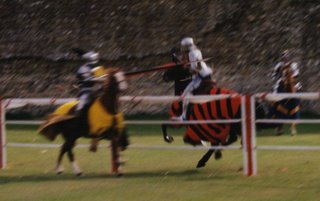
The next day, or soon thereafter (days kind of blur for us) we were taken to Portchester Castle, to see our very first medieval tournament. Heather was enthralled by the archery and falconry displays, while I enjoyed watching idiots on horseback run at each other with long pieces of wood and expect to survive. Our guy won, even if we were only cheering for him because we happened to be standing by his tent, but hey, take your wins were you can. Kerry and Simon became the Bravest Travellers ever by purchasing their three children wooden swords and bows! We took a side trip to Portsmouth Ferry terminal where we were told a trip to Spain would cost around £250, only five times the expected price! After leaving and reading the companies brochure we discovered the price to be £44 so now we must work that out, but it gives us the opportunity to stay for Sam Middleditch’s birthday party, next Saturday.

The next day Heather and I took advantage of significantly lightened bikes (dropping our panniers off at Brian and Syl’s) and biked down to Lepe Beach. For those who are not British I should clarify that anything called a beach in England might qualify as a gravel road at home. The Brave Traveller was delighted to see her tree still standing, the one in the picture titled "Roots" for art enthusiasts and proud print owners.

Today we are being hosted by the Middleditches (I remind Nick that all names are spelt phonetically!), Nick and Maxine, who have kindly excused my eccentricity as I got over to their house and disappeared from sight into the computer room.. I’m not a recluse, really. Maxine, the decorator of our cake by the way, has promised to show me to a photo developer so I can send pictures home (I’m getting pretty anxious to see my fingerprints enlarged fifty times). We have also been promised a visit to the local candy store. I think Nick and Colin have an arrangement on the side. Nick rots our teeth and they split Colin’s dentist fee!

Next on our agenda is Spain, with a week or two rest and argument with P&O ferries first, but at least the ferry terminal is only a bike ride away. So until the next time I can write, hope everyone is well wherever you happen to be, and we will contact you as soon as we can again.

Love

The Brave Traveller and the Fearful Voyager

P.S. If anyone owns a really big yacht could they please ferry us over to Spain? Or maybe we can hook pontoons to the bikes, hmmm……

P.P.S. If anyone see’s Brian and Sylvia while we have switched places, Nick gently reminds Brian that he was given a single, simple, task to do from Canada

Next Entry: Sept 11. 2001.
Previous Entry: Topless Women Ride Free

Thursday, September 08, 2011

Day 33. Portsmouth. Sept 8 2001

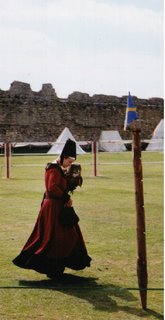
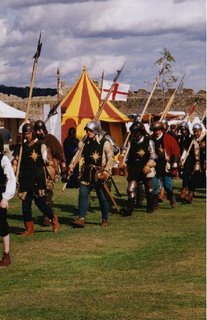
We took a trip into Portsmouth to see a medieval tournament at Portchester castle. It was very exciting for both Heather and I.

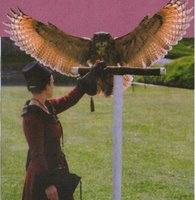
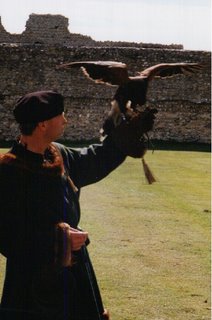
Heather was enthralled by the falconry display. To watch a predatory Eagle Owl, with talons as long as my fingers under the control of a slip of a woman was enchanting.

Heather was also very interested in the Archery display, talking about taking classes when we return home.
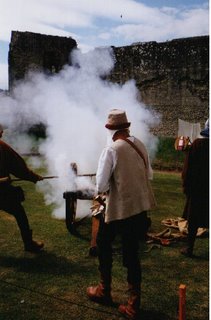
 
I was interested to compare rates of fire for the difference weapons. 18 shots a minute for a bow to 12 for a crossbow and 1 for a musket. The cannons fired 2 with a crew of three.


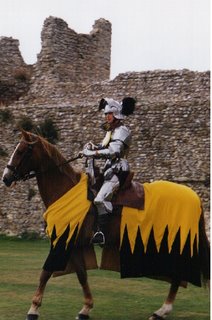
The most interesting aspect for me was the joust, something I had never seen before. The rules are different than Hollywood has led us to believe and there were no unhorsings.


Our knight, Sir Edward Stacey,

 
won the joust while another won the grand melee.

 
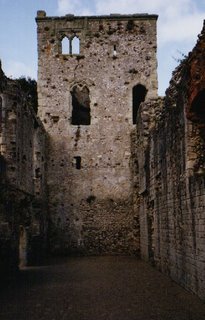
To see in action things I have studied and in such a setting was almost magical. The castle itself was a solid structure that from a distance looked like the classic ideal of what a castle should be.


It lost little of its appeal close up.

 
From Portchester castle we drove into Portsmouth ferry terminals where we had a long conversation with the Spanish lady at the Bilbao counter who didn’t understand English even though she spoke it and she quoted us ferry prices five times higher than we had expected causing us both a lot of depression that lifted slightly when we read their brochure and saw something like the prices we had anticipated, but we still have to spend time sorting things out.

On the way back we passed Whale Island, where you could still see the ancient submarines askew in the water as they awaited their ultimate fate.

Next Entry: Day 34. Lepe
Previous Entry: Day 32. Holbury

Thursday, September 01, 2011

Day 26. The Sea Sept 1 2001

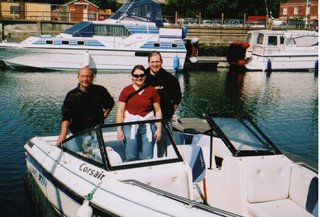
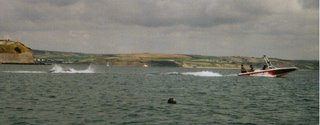
Colin took us out in his boat today.

Though our voyage on the ocean waters was brief it was exhilarating and soothing. Our trip amounted to merely dipping our our toes in almost infinite waters, yet it was easy to see how the ocean had inspired poets through the ages, from Homer to Melville.


The ocean is something so primal that it seeps between heart and gut and grabs hold. Perhaps the memory of it is so deep in our cells that we can never forgets and the sound of crashing waves call us home.


Perhaps the similarity between sea and blood calls out to each other and the rhythm of the sea controls the beating heart. Whatever the attraction it is easy to understand the despair the sea can also evoke, for what writer can find the words to convey all that the infinite sea can define with its mere existence.


Drinking from the wine dark sea was tiring and when we returned to the hard shore our exhaustion was great and we slept through the afternoon, a rest that would have grievous consequences on the nights sleep.

We met Hayley’s parents and found that Hayley's Father and Colin are two men cut from the same cloth. They are both thrilled by anything that is man-made and fast and preferably more than a little dangerous and they love hashing out tiny details.

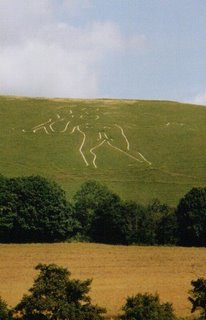
We drove about Dorset countryside alot today, a most beautiful country. On our trips we passed the Maiden Castle, a native hill fort conquered by the Romans which I would dearly love to explore but for which we did not have time. We did, however, manage to stop at the giant of Cerne Abbas, a great chalk figure carved out of the turf on a hillside, outlined in white. He was well muscles and brandished a club and no one could say his true age. He also sports an enormous phallus, which made him the butt of many jokes but also a fertility symbol of some power and, we were told, was usually populated at night by great herds of beasts with two backs.
We had the strange and slightly surreal experience this evening of watching what was deemed an important football match between England and Germany. Given the energies involved, and the intense emotion, I can only be glad that the two formally warring powers have chosen sport as the ground for their future conflicts.

Next Entry: Day 27
Previous Entry: Day 25. Dorset Steam Fair