Showing posts with label Mont St. Michel. Show all posts

Wednesday, October 05, 2011

Day 60. Le Mont St. Michel. Oct 5 2001.

We arrived today with tide still in and what a difference it made. From a rock, albeit a beautiful rock, sitting in gray mud, The Mont was transformed into an island floating on a sea of blue. The parking lots of yesterday had disappeared beneath the waves and the Mont was connected to the land only by a narrow ribbon of rock and concrete. But even as we watched the tide receded and special trucks rolled out to wash the silt off the parking lots and another day began at Mont St. Michel. We walked up the thousand steps to the abbey, then a hundred more to the entrance and we took our place among the waiting throng. I will share our tour.

We began in the Hall of the Guards, the abbey's fortified entrance. Here, in times past, the knights of Mont St. Michel would guard against attack or officials of the government would greet new prisoners and now a young lady checks your ticket. From the hall we climbed a hundred stairs more, along the Staircase of the Great Degree, the access way to the church of the abbey. On our left rose the great walls of the abbey's lodgings, on our right, the walls of the lower churches buried beneath the great church. On either side the walls rose so high that all that remained was a thin slice of blue sky above. Sometimes even that disappeared under the fortified bridges through which the monks traveled between church and bed. Finally we rose out of the depths to the Terrace of the West.

The terrace granted pilgrims a panoramic view of the bay and the seething town on the slopes below.

  It was wide and flat and it was here the official tour began. With our small tour, numbering only in the low hundreds, we entered the abbey of Mont St. Michel.


Like most other Christian churches in Western Europe it was in the shape of a cross. The nave was done in Romanesque architecture with thick pillars supporting soaring barrel vaults. It was in three layers, the first the barrel vaults, the second, perhaps thirty feet above ground level was made of tiny arches and the third was stained glass windows. The choir, or head, of the church had been redone in a flamboyant gothic style with pointy arches inside and flying buttresses outside. At the top you could see the flame shaped carvings from which the flamboyant style took its name. The choir had been rebuilt when it had collapsed in the 15th century. The entire abbey, except for the exact middle, was supported on smaller churches built up on the island. The center was the only portion supported by rock. The abbey was vast, but virtually devoid of decoration.


In the center was a carving of St. Michel in his third aspect, the warrior angel, charged with fighting the forces of Lucifer wherever they may be found. Satan was expressed in the shape of a dragon, hence the gilded statue at the pinnacle of the church, of St. Michel slaying the dragon. Too bad, I like dragons.

From the abbey we were led to a piece of heaven on earth, the cloisters of the monks. The cloisters were square, as all cloisters are, with a double row of columns separating the walk from the open aired garden in the center. Here the monks came to meditate on the chapter of the bible they had read that day. There were 137 columns, 1 for the only god, 3 for the trinity, 7 for the perfect number. The columns were designed to set a pace for the monks as they wandered in contemplation. Each column on the inside row came down exactly in the middle of the arch made by the two columns on the outside row, one pace forward.

The arches between columns are covered in sculptures depicting plants that would normally be found in a cloister. Hidden among the stone plants are fiendish monsters to remind the monks that evil lurks everywhere. Unfortunately the sculptures often depicted evil as being extremely cute so I’m not sure it had the intended effect.

Cloisters are supposed to be enclosed structures with no view of the outside world to distract from mediation but here a door opened out to a view of the bay, a least a couple hundred feet above sea level and over a hundred in a sheer drop. The monks had opened it as the beginning of a project to build a chapter house and run out of funds. Only recently had a pane been put in to protect people from the drop, perhaps the monks had kept in open to escape from meditation.

Most cloisters have a garden in the center. In the 1960’s it dawned on someone that this one did not, so they rectified the situation by adding one. But the monks weren’t stupid. Below the cloisters is the scriptorium where they copied books and a garden overhead means water below so now they are in the opening phase of removing the garden, after it wrecked the plaster of the scriptorium.

From the cloisters we moved into the refectory where the monks had eaten their meals. A vast silent room, except when filled to the brim with a tour, at which point it became impossible to hear anything for the never-ending echoes. Here the monks would eat bathed in light that swam in from cunningly concealed windows and filled the room.

Our tour guide next raced past the Salles des Hotes (because that was were the tour was supposed to end) and took us down a never ending flight of stairs and around the back of the central peak of the Mont, concealed behind a wall of thick bricks. Eventually we emerged into a small chapel were the only remaining fragment of medieval fresco on the Mont was hung. The chapel stood between the infirmary and the ossuary, the place of bones, to remind the monks that they were still mortal. The fresco depicted three dead people reminding their living selves that death always lurked. Cheerful thing to have in an infirmary.

From the chapel we went to the Room of the Giant Hamster Wheel.

The Room of the Hamster Wheel was actually the ancient ossuary where the bones of dead monks had been stored. But the French revolution has seen those destroyed and the authorities of the prison had transformed the room to a supply room. Here the supplies were hoisted up a long steep ramp on sleds pulled by prisoners running in the hamster wheel. Strangely enough the monks had used a similar system on the north side of the Mont, which the revolutionaries had destroyed, only to find they had no way of getting food.

From there we went to another chapel, this one acting as a support for the south transept of the church. It was in almost complete darkness because the prison had used it as a cistern and all the windows had been walled up to keep the water in.

Next came The Crypt of the Big Pillars and unlike the room of Giant Hamster Wheel, I am not making this name up. This crypt has stored no dead and served no religious functions. Instead it housed enormous pillars that supported the choir of the church. Each pillar was a gothic pillar, completely enclosing the Romanesque pillar that had existed previously. In a small corner of this crypt was a gilded golden statue of the Madonna and child atop a globe blue with silver stars. A sister church in Spain had given it to encourage the reconstruction effort. Nice place to store such a gift!

Finally the tour led us back to the Salle des Hotes and the Salle des Chevaliers, with a stop in the scriptorium. The scriptorium was an enormous room where the monks had copied manuscripts all day long. To give them consistent light the only windows were to the north and these were small round circles that looked out like portals from a vast ship. You could see the decay in the plaster from the garden overhead.

The Salle Des Hotes was the chamber where the nobility had been entertained and had once been richly decorated in the blue and stars of the French Crown, but was again destroyed during the French revolution. Finally the Salle des Chevaliers, where the knights would sleep, and the end of the tour.

Here everyone filled passively down the narrow stairs though the guide had invited everyone to stay and explore on their own. We were the only ones to stay. Now we discovered the Mont’s greatest secret. The tours come in waves and everyone, everyone, stays with their tour. In the troughs between the waves the Mont is completely deserted. Imagine all the rooms I have described, filled with a hundred, two hundred, people, then going back and finding them completely empty.

We were like two kids in a candy store. We ran from room to room with delight. We retraced the entire tour and saw everything with no distracting presence. Heather especially loved the cloisters and we spent a lot of time there.

Eventually we found our way back to the abbey and discovered a staircase down to another chapel and here a community of monks and nuns were having mass. We stayed for the service and it seemed to place the whole structure into context. Though we might not necessarily agree with the message expounded in the mass, it was a very beautiful ceremony and it brought home who the monument should really belong too. It seemed strange that with this massive religious edifice all around us the monks and nuns should be shunted off to some deep grotto so as not to offend the eye or to interrupt the tour. They are the soul of the Mont and without them it is merely the dead remains of a once living body. We left feeling better for having seen the service and having participated in our own little way.

Finally we descended the innumerable steps of the exit

and emerged in an enormous gift shop near the entrance. It seems that humanity will never tire of buying tacky objects. Though what we would do with a tin of cookies shaped like the Mont, except eat them, escapes me.

We then circled the Mont to visit the tiny chapel at the rear.


It had been a long and beautiful day and as we biked back the 12 kilometers to our campground we were very happy.

Next Entry: Sens De Bretagne
Previous Entry: Day 59. Le Mont St. Michel

Tuesday, October 04, 2011

Day 59. Le Mont St. Michel. Oct 4 2001.

How do you describe a marvel? Le Mont St. Michel is everything that has been said about it and nothing like what has been said about it. And we didn’t even go in. Today was a day dedicated to exploring the exterior of the Mont and the small village that shares the rock.

What a contradiction is the Mont! A place of infinite beauty emerging from a vast mudflat. A place of holy pilgrimage where dogs defecate in the street. It is an Alice’s wonderland with tiny medieval streets that are filled to capacity. Turrets poke from crenellated walls and the chefs in the cafes beat out a rhythm in their copper mixing bowls. Even the resident cats, in Alice fashion, are pure white or pure black with nothing in between.


The Mont, so the story goes, is the result of a dream, or rather: three dreams. Aubert, the bishop of Avranches, dreamt one night that the archangel Michel appeared to him and commanded him to build a sanctuary on the Mont that arose from the nearby bay. Aubert awoke and shrugged off the command as a dream. Night fell again and again Aubert was visited in his dreams by the archangel. Aubert awoke once more and still shrugged off the visitations as a dream. The third night Michel appeared yet again, the time angered by Aubert’s unbelief. At a word from Michel the archangel’s hands burst into flames and to press home his point he laid a burning finger to the bishops head and repeated his command. Aubert awoke in a sweat, terrified by the vividness of the dream. As he wiped away the perspiration of terror his hands touched his head and he found there a hole burned through his skull. Aubert denied the archangels commands no more.

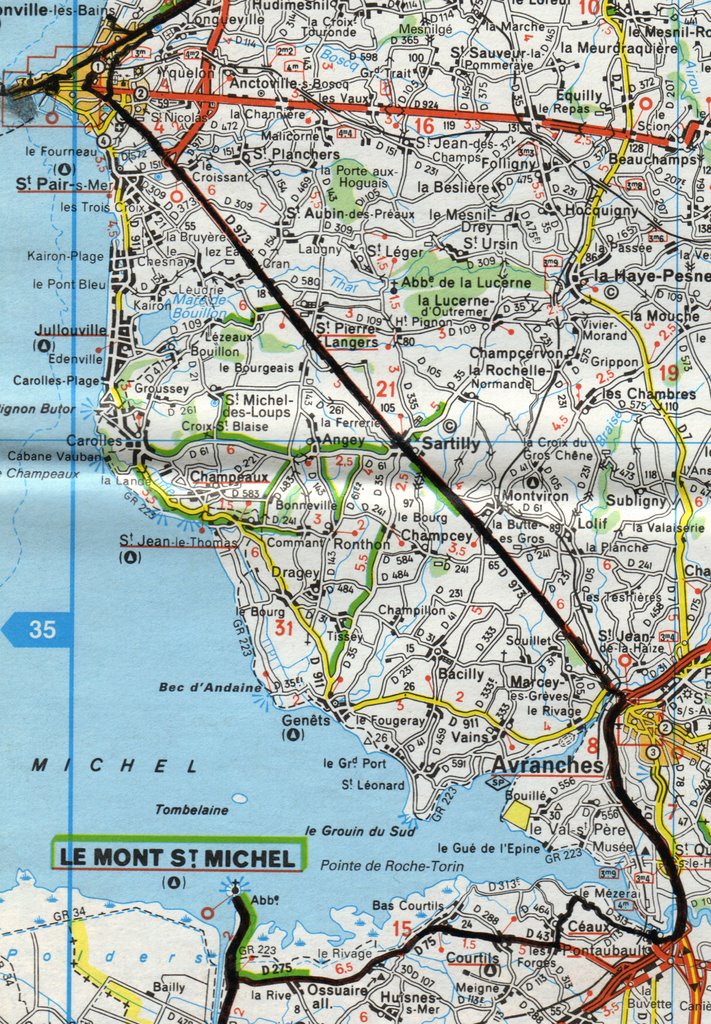
Our long ride in to this, the most current phase of Aubert’s dream, began in Courtils. We left our tent and our gear behind and followed the coast road. Le Mont rose above all the surrounding fields, sometimes shadowed by clouds, sometimes centered in a ray of shinning light. As we drew near we noticed something out of place. It seemed as though the golden figure of the archangel, crowning the mount, was desperately trying to out-fly a net cast to ensnare him. The whole steeple was shrouded in sinister scaffolding as the cathedral was being restored.

Over us flew French fighter jets, their roar echoing across the flatlands mimicking the American jets we had seen the day before. In the Hundred Years War, for a time, Le Mont St. Michel had been the only northern outpost of the French, surrounded by hundreds of miles of terrain captured by the English. The monument thus became a mighty military symbol, as well as a religious one, to the French. The fighters seemed to signal the fact that the military aspect of the Mont was not necessarily at an end.

Finally we reached the causeway that led out to the monument and advanced along it.


We had come when the tide was out and the Mont seemed to rise from an ugly sea of mud. All around were parked tour buses and motorhomes and cars. Hundreds of school kids and geriatric tourists flooded over the monument while we biked near to the gates, fitting easily, after a confused search, into an area restricted to those who worked on the monument. No signs guided us in so we followed the mass of people, who clogged the gates and the streets like so much blood in a congested artery.

The main street that curved up the Mont was purely medieval, with the walls of the buildings on each side no more than a double shoulder width apart. The upper floors overhung the streets and soon we were plunged into darkness.

Thankfully the seemingly endless stairs climbing the Mont acted as a sieve, filtering out most of the crowd, who never made it past the tactless tourist shops and tacky museums declaring “Dungeons, Prisons, Tides and a Periscope.”


By the time we reached the top, where the abbey began, the crowds had thinned to a mere throng and we could almost breath normally again. But almost half of those who made it this far were accompanied by their pet dogs and the upper reaches were full of yapping, drooling, snarling animals. So much for holy ground.

Fortunately for us the Mont is a rabbit’s warren of side passages and secret stairs leading to secret gardens. We escaped through a path running just behind the roofs of the first few buildings and found a deserted garden overlooking the gates that guard the Mont, near a place called the Gabriel tower. Here we ate our lunch in peace, disturbed only by a black kitten seeking refuge from what was, on this day at least, a dog’s world.


Once we finished we descend via the Chemin Des Ramparts, the road of the ramparts.


Few people bothered with that road and we became amused, it must be said, as we peered through the few spaces between buildings at the people packed cheek by jowl in the street below.

I don’t like to denigrate the bus tours that ferry people about Europe. Everyone must travel in their own way. But something seems wrong to me about the tours that grant only an hour to explore a monument that takes a hour just to climb.

Eventually we were forced to descend from our perch on the walls and find our way into the alcoves where the phones were, so that so that we could let family know that we still breathed. My water bottle burst as I spoke on the phone, drawing disgusted stares from passing tours that must have concluded that I couldn’t hold out for the bathrooms a few meters away.

I greatly enjoyed the phone calls home, not just to speak to family, but for the chance to watch an elderly oriental man in wooden shoes who was having the most agreeable time photographing himself as I talked. Why anyone would be so happy to have a picture of themselves in front of the automated teller at Mont St. Michel, or in front of a blank brick wall, or standing alone in a crowd of people, is beyond me, but he seemed so happy doing it that you couldn’t help but be delighted for him.

We left the monument to eat our dinner in its shadow and to watch the tour buses go by. Heather cannot help but throw food to disabled animals and scraps of bread to the one legged bird soon became an overhanging umbrella of seagulls. But any negatives eating outside might have brought were soon dispelled by the busloads of younger tourists that began divesting themselves of their clothing after a walk through the mud flats.

Finally we left for the day, not forgetting, of course, the dog that peed on me as we left the main gates. As we got home and settled into our sleeping bags in preparation for tomorrows climb and tour of the inside, the bells rang out once more, a hundred and eight times. They seem to do this at every sunrise, noon and sunset. At least we have a wakeup call for tomorrow.

Next Entry: Day 60. Le Mont St. Michel
Previous Entry: Day 58. Courtils

Monday, October 03, 2011

Day 58. Courtils. Oct 3 2001.

Today we had planned on stopping at the intermediate town of Avranches and reaching the towns near Le Mont St. Michel the day after, but plans, especially plans made by us, get changed.

We set off late from Donneville-les-Bains. It had seemed that we would be trapped there forever, the cyclists black hole. Olivier was very sad to see us go. We had been the only people he’d spoken to in a week. All the French people answered him in English, a language he could barely understand. Apparently I was the first person to talk to him in French in a long while.

Today’s trip began with difficulty and remained that way. First we had to push ourselves up the hill out of the campground, then, after buying groceries, we had to push ourselves up the hill on which the train station rested. By now we were ready for lunch.

As we sat eating, Granville’s air raid sirens went off. They seemed to go on forever. We looked around nervously but the locals just ignored them, so we followed their act. But continuously sounding air raid sirens would get under anyone’s skin and it made us both jumpy. There are things that go on in the daily world that scarcely faze you, but when you are a stranger in a strange land, without being plugged into the local information system, everything around you takes on a strange cast. It’s like watching a television show in a foreign language. You see everything that goes on, but nothing makes any sense.

After lunch we climbed the final hill leaving Granville and set out in the direction of Avranches. On the map the road was very straight, but, as we had feared, it was very hilly. Still, it was the first sunny day in a while and we enjoyed the good weather while it lasted. The French drivers seem to be getting ruder the farther into France we go. Many of them seem to take a perverse pleasure in getting as close to us as possible and sounding their horns. What they hope to achieve by this is beyond my understanding. They aren’t going to get us off the roads that way and since, if they scare us enough, the worst outcome is us falling off our bikes and under their tires, with the result that they end up in jail for manslaughter, it seems like a pretty stupid thing to be doing.

As we rode through the French countryside we passed a couple of fabulously decorated manor houses, obviously still occupied. The one that stuck out was right beside the road, square with great oval flares around the circular windows at the top. There was a double drive leading to the scrollwork-covered staircase at the front entrance and a garden that seemed to go one forever behind. It looked unscathed from the renaissance until now. Very enchanting.

Also on the road, at one of the steep parts where we were forced to walk, was a dead cat, struck down by a car or truck. To Heather, who lived most of her life with cats, it was very disturbing and even for me it was the worst road kill we had yet encountered.

Finally we crested a hill and there, off to my right, was the distant hazy image of Mont St. Michel. I pointed frantically at it, but Heather ignored me until too late, the Mont had disappeared behind a grove of trees. By the next clear patch the Mont had disappeared and I’m sure that Heather thought I was hallucinating. Sunstroke perhaps. After a mile or so, I was inclined to agree with Heather because, thought the right side of the road remained clear, there was no more sign of the Mont. Finally, as I was beginning to doubt my sanity, the Mont emerged from behind a rise so small and gentle, that neither of us had been able to notice it. Even from so far away you could easily discern the rugged shape and the peak of the Mont. It stands out in sharp contrast to the green hills behind, almost like a shadow. At the height of its power there is no doubt that it was awe inspiring and probably produced more than a little fear in the local peasants.

Soon our attention focused on a more immediate fear, the town of Avranches loomed up before us, a medieval city built high atop a great hill with sheer cliff surrounding it.

The only road into town rose along a steep and long path to the base of the city walls. We needed a break before we even contemplated going up that route. We stopped in front of the local McDonalds and ate our food, unfortunately not McDonalds food. Our cholesterol dependant bodies cried out in anguish, but we resisted temptation. Heather was worried about us eating no-fast food on their lawn. I figured that we had given enough and it was about time that the fast food industry gave something back.

As we ate I looked through the map and discovered that Courtils, another planned stop, was not all that far off and it was only 2 hours past noon. Because it was such a warm day, with so little wind, we decided to push on and avoid the steep climb to Avranches. To follow our chosen route, however, we were forced to travel on a major four-lane highway. The highway was slated to become an autoroute next year but was still open to bikes at this stage. This fact did not discourage every driver we encountered from honking wildly at us at they passed. Nor was the shoulder particularly pleasant to ride on as it seemed to be a major centre for the disposal of glass.

Oh yes, I have failed to mention that the valve on Heather’s tire failed this morning, leaving us in a precarious position with only a single replacement inner tube left.

Somehow we managed to get off the highway intact, but it was not an experience either of us would care to repeat. We left the highway at Pontaubault, a small town with another bridge the allies had tried to bomb out, only to fail. It must have been pretty difficult to hit anything fifty six years ago. But the allies must have been pretty happy to miss because after the town was liberated it became Patton’s main access point into Brittany and most of the third army crossed that bridge.

After the town we passed some exquisite houses on rises where they could see the Mont.


Here in France the turret seemed to be a popular design feature on country houses, even when they are obviously modern houses.

At last we arrived in the town of Courtils. We passed a little through it, lured by the more expensive campground adverting a heated pool on the other side. But, despite the pictures, the pool was about as attractive as the average cesspit, so we sheepishly retreated to the campsite in town. It was cheap and clean and right across from a field of cows, which made things a little tense as I am allergic to cows and Heather has an inexplicable terror of them. I believe that in a previous life she was gored to death by an enraged cow...

or perhaps not.

Finally we went to bed, only to discover a little ridge beneath us so that no matter which way we slept, our feet were higher than our heads. We eventually managed to fall asleep, only to wakened by the local bells sound a hundred times at midnight. Nice.


Next Entry: Day 59. Le Mont St. Michel
Previous Entry: Day 57. Donneville Les Bains