Showing posts with label Art. Show all posts

Tuesday, November 08, 2011

Day 94. Gradignon. Nov 8 2001.

A rainy day at home, doing preparations of our train trip to Avignon. A respite from racing around the narrow streets of Bordeaux and a chance to catch up on writing.

There was such a flurry of things that passed us by in the last few days that I was bound the miss a few. Most glaring among the omissions were the plethora of names left from my list of famous painters who failed to make much of an impression on me.

There was a painting by Van Dyck, one by Rubens, Chardin, Van Gogh, so many that they were beginning to flow like water.

Delacroix’sLa Grece Sur Les Ruins De Missolonghi" was stunning and powerful and if it had been in a room alone or with two or three other paintings, each chosen specifically to highlight one another it would stop you in your tracks and force you to explore the visual details for hours. But here, mounted with a hundred other paintings it became nothing more than wallpaper. Nice wallpaper, but but wallpaper nonetheless.

I can't remember if I wrote about the statues lining the entire second wing and I am too lazy to check so I will, perhaps, repeat myself. Only three in particular caught my attention of which I know the title of one and none of the artists. The one whose title I remember was “La Garonne” an allegorical representation of the river Bordeaux faces. It was a bronze of a woman reclining in a flow of water, leaning so far back she is almost lost in the waters. On either side of the flowing water is shore composed entirely of grapes.

It was beautiful but that was not what caught my attention. The piece seemed composed entirely, I’m sure not by the artist's original intention, of irony. Nowhere along the Garonne had we seen anything to evoke beauty or tranquility. Instead the river was a churning mud mess with the detritus of a thousand kilometers choking the banks and spilling out to smash against the docks of the city. Perhaps the artist was thinking somewhere upstream.

The other two that caught my eye seemed to belong to a set. They were statues of women out of marble that had obviously been outside for a very long time. They were weathered and scratched were vandals had gotten to them. One was of a young woman with the idealized body of womanhood, large breasts but perky in defiance of gravity, thin waist, well muscles arms and legs, almost a doll-like form.

The second was a woman, still beautiful, but now with a form that was humanly possible to achive. Full breasts that curved lower across her chest, a more curvaceous figure, fuller but more sensual, less heavily muscled. The pair seemed to show the ideal of beauty and the reality of beauty.

The Museum of Aquitaine, from the day before, had many exciting works of art, many pieces that seemed to capture the feeling of an era, and they were displayed exceptionally well.

The remains of Roman statues, often only the chest and stubs of neck, arms and legs, had lights trained on them to give them a unique glow, or were mounted against a red wall to contrast with the white pallor of the statues. The most impressive piece in the collection was the bronze figure of Hercules striding purposefully through the room. His face seemed so alive that his sightless eye sockets evoked a sense of pity and dismay at the blinding of such a powerful figure.

Many of the Museum's Gallo-Roman pieces had come as the city was excavated to make way for new buildings. One particularly rich source were the excavations for a supermarket's parking lot. Interestingly, since the supermarket was destroying old buildings to get their parking spaces the city of Bordeaux forced them to preserve the facades, so now shoppers park behind 18th century homes.

Another portion of the museum that really caught my attention was the few model ships on display, although by the time we saw them we were hurrying through the museum to see as much as possible before it closed. There is something so intricate in the workings of a model ship. Even thought they can reach enormous size the detail is amazing and the knowledge required phenomenal. I remember at the naval history museum in Southampton they had displayed the bone model ships made by the French prisoners of war and the guest book had commented derogatorily about the lack of correct detail. You had to ask if the people writing the comments could have done better. It would be fun to make model ships, but there is something infinitely sad about a person making models of ships when they live twelve hours away from the ocean.

Today the rain had mingled with the cold to become a real danger. The water runs through the rocks like the beginnings of a river and though our belongings are wrapped in plastic they are beginning to get wet as the water seeps upward. Somehow the waterproof groundsheet of our fabric home has become waterproof no longer and the spreading stains of the damp congeal into puddles within our tent as we watch, as if the water is willfully forcing its way through the plastic.

I peer outside and see a torrent of water that streams down the gravel road of the campsite. Rain in November is new for us and I can see suddenly why the world sneers at the idea of warmth in Canada. For Calgarians the best we could expect in November is clear skies, the worst, heavy snow. Never rain.

I am reminded of our trip to Prince Rupert where we were almost rained out completely. Yet it was a very rewarding trip. Not so much in the conventional fashion of most vacation, but because it revealed so much about the inner workings of our vast country and the diversity of the people who call it home. The Tsimshian people were so proud of their heritage and their homeland was so beautiful. Deep fjords, misty islands and rain drenched forests.

Somehow I am back on the topic of rain. It will be, I fear, a dominant theme.

We stopped the other day, on our way back from grocery shopping, at the ruins of a wine making estate on the road towards our campground. There was a twelfth century church and an old estate home, both closed to the casual tourist such as we. But the garden was magnificent, overreaching green trees making a ceiling of foliage, only a few leaves clustered on the ground dropped from their lofty perch. There was a pathway of concentric arcs through the green grass and it was lined with flowers of all description, still in bloom. While we stood there the cold chased at us through our jackets and sweaters, chilling skin and making us long for warm soup but it left everything around us untouched. It was as if the cold taunted us and made us imagine that the cold was only in our heads. the beauty made it seem that we are trying to flee a phantom that cannot harm us. But the rain that beats a staccato rhythm on our huddled shelters is real, it has an icy grip and we have to try and get from beneath it, at least for a while.

Bordeaux, despite it’s generous museums and hidden beauty has been a disappointment. The grandeur here has faded beneath a veneer of indifference. You can still see the magnificence, like a beautiful painting left in a puddle of mud at the roadside, but its faint manifestations are almost sad. I know that we have not been charitable to the city, nor credited its successes, the museums and the shopping district, enough. But when cities that boast only half the population, or even less, seem to make more of an effort to show what little beauty they are gifted with and seemed to take so much more pride in their patrimony, you are little inclined to be charitable.

Or perhaps you cannot blame cities but must look more to the individual. Even in Saintes there were those who treated crypts as garbage cans, in La Rochelle those who pissed on the street. There is always a certain percentage who do not give a damn for beauty or heritage.

I cannot help but feel pity for those who strive so hard to make their city beautiful and are defeated by an uncaring few. It only takes a few to ruin it for the many. Michelangelo’s Pieta was wrecked by one crazed man.

At least the people seem to have been very friendly particularly our ticket agent and the guy at the museum. Friendliness makes up for a lot but not the tons of dog shit and not, for us, the rain.

Next Entry: Day 95. Nimes
Previous Entry: Day 93. Bordeaux

Monday, November 07, 2011

Day 93. Bordeaux Nov 7 2001.

If yesterday was busy then today was only slightly less so. We awoke, hungover from our disastrous encounter with a wine bottle, got dressed and headed for downtown. Today was much warmer than yesterday, which is not to say that it was warm.

Today’s long bus ride had none of the relaxing qualities of yesterdays. Our driver was determined to complete his shift as soon as possible and careened down the street with frantic speed, running lights, skipping stops and accelerating with stomach churning speed. By the time we were dropped at the base of the arch in the Place des Victories our heads were spinning more from the ride than the cheap wine.

We followed a side street to the train station and passed by the University of Bordeaux’s medical building. There was a statue out front of a full bodied woman labeled “Nature” lifting her skirt over her head.
We found our way to the Market of the Capuchins and wandered among the fresh crabs, tomatoes, cheeses and rabbits with their fur still on. The place swarmed with activity.

We did eventually make it to the train station and were helped by a man who seemed so genuinely delighted to be assisting people that he should have been the rail systems official spokesman. After finding out the prices for Nice and Rome yesterday we had come to an official decision. We would go to Avignon.

It was impossible to get a direct train there and still take our bikes but our helpful train representative almost exploded with delight when we found an alternative way to go. Every once in a while you encounter people so happy with life that their attitude is infectious. In Bordeaux we had encountered two.

 Last night at the Museum of Aquitaine the desk clerk had been so delighted when we were surprised by the entry fee of nothing, he had leaned acrossed the desk and whispered conspiratorially “Don’t Tell Paris.”
Today our SNCF rep, after I apologized for my horrible French, had leaned across the desk and said “At least you are better than the British.” 

We walked back to the market after buying tickets and Heather looked longingly at all the fresh produce. Then we headed for our goal of the day, the Museum of Beaux Arts.

We followed a little used back alley and came upon a spectacular gate in the old city wall with an intricate medieval clock in gold, silver and red mounted by a massive bell and a pair of turrets. The gate was romantically named the “Gate of the Big Bell.” Who says poetry is dead?

From there we followed the road of St.Thomas into an intricate warren of medieval cobblestone streets fronted by art stores.

Eventually we found our way to the Museum of Beaux Arts and, shouldering our way through the people drinking in the entrance, we made our way in.

The museum was nice enough, a long hallway in each wing divided into separate schools or themes. But Heather got more out of it, especially the first wing, than I. She was delighted to find examples of techniques she had studied in art school, but to me most of the paintings blended into a nice background.
The Dutch and Flemish schools of Art might have a lot to offer but I found little attraction in paintings of dead ducks and birds hanging on walls or still life paintings of decaying dinner.

There were many high profile names in the museum, Matisse, Delacroix, Renoir, Picasso and their works were spectacular. A Renoir of blowing trees was inviting enough that you could almost step through into the windy forest. The Picasso of “Olga Reading” seemed transitional between his early phase, when he drew realism, to the beginnings of his more impressionist style. Even Titian made an appearance and there was a bevy of Delacroix's on the walls.

But typically it was not the big names that struck me with their beauty, There was a painting of the Sphinx by an artist whose name I have forgotten where the sand seemed to flow like water and the hard stone had a liquid quality. It brought to mind H.P. Lovecraft’s assertion that the Sphinx concealed something of immensely ancient evil.

But the most stunning one of all was a life sized painting by Henri Martin called “Chacun sa Chimere” the visual realization of a poem.

“They came from we know not where and they go to the morning of desolation of their dreams unrealized.”


A procession of people across a desert following hopelessly after Winged Victory and Youthful Glory, each bearing their demons on their backs. It’s scale and power were overwhelming. The rest of the museum paled in comparison.

The naked ladies were nice though.

From the Museum of Fine Arts we went to the Museum of Decorative Arts where there was an exhibit displaying posters from the Salon Des Cent, including works by Toulouse Lautrec. I was more enthralled by the Art Nouveau pieces of furniture in the rooms as the rest of the Museum was mostly porcelain collections from old hotels. Nice, if you like plates.

From there we walked. First down the Rue Des Trios Conils where we stopped at a fantastic Bonsai tree shop. The floor was smooth river pebbles and the scent of green living things filled the air. Behind us was the Place Gambetta, a beautiful park surrounded by heavy traffic where 300 people had lost their heads during the revolution.

From here we walked to the Rue St. Catherine where yesterday I had seen a child prostitute for the first time in my sheltered life. She had smiled coyly in her backpack and little girls clothes while nearby a sinister looking man whistled tunelessly and flipped through a magazine without seeing it, eying instead the passersby.

The rue was a pedestrian mall where all the most trendy shops were. We had visited the Galeria Bordelais yesterday, a covered arcade in neoclassical style, so today we walked south, the Arch of the Porte D’Aquitaine our landmark at the far end.

The shops were great to browse but we soon became hungry and had to search out a supermarket. As we scurried about buying groceries I somehow attracted the attention of a security guard who followed me about the store, picking up a single box of food to look as though he was a regular shopper. Eventually I opened my jacket show him I had nothing hidden and he slumped away in angry disappointment.

From the supermarket I wanted to go to the synagogue that the Nazi’s had used as a prison in WWII but the police vans and men armed with machine guns out front gave us pause. Watching the Bordeauxians walk around them without concern I walked to the gate of the synagogue to go in, at which point the police started to yell at me that it was forbidden. Prudence being the better part of valor, we didn't go in.

The police presence in the middle of Bordeaux had begun to swell alarmingly. Every corner suddenly seemed to have armed men on it. We thought it would be a good time to leave. Whether something was happening or there were always that many police, I don’t know.

Next Entry: Day 94. Gradignon
Previous Entry: Day 92. Bordeaux

Tuesday, November 01, 2011

Day 87. Saintes Nov 1 2010. ‏

Sometimes the words to describe a sense of awe, beauty, wonderment and an almost overwhelming feeling of ancient power, simply do not exist. It is the difference, to borrow a phrase, between talking about lightning and being struck by it. But I will try to put words to the indescribable.

We awoke early today, worried about missing breakfast. Our alarm had cratered a couple of days ago and now only makes a horrific noise whenever it is opened. As it happened we didn't miss breakfast, we were the first ones to it. It was the same fare in La Rochelle but enjoyed much more because we were expecting it. This time we both stole jam.

After a brief morning nap we set out. There was no exploration today, we were both sure of our goal. We cycled up the steep streets directly for the Arena. We locked our bikes against the metal rail that surrounded the upper rim of the site, paid our five francs entrance fee and walked in. Here words fail me completely. I have to pause and think for even the smallest description to come to mind.

I have spent the last five years studying histories of people long since dead, the Romans foremost among them and, Virconium and Rockbourne Villa aside, I had scarcely seen a Roman site. Walking into the arena was like walking into a physical manifestation of these past five years, each stone a word in a textbook or a minute in class. In mere seconds I felt Rome, the weight and history of Empire, as no book could convey. I could hear the roar of the crowds, see blood flow on the sands, smell the sweat and excitement. I travelled time as I walked the steps, phasing effortlessly between the now of grass and ruins and the then of living breathing history.

The arena was an enormous structure built to hold between fifteen and twenty thousand people, the entire population of Mediolanum Santonorum. It was a mixed structure so that some was built into the sides of the valley while other parts, particularly the Processional Port of the Gladiators rose from the valley floor in enormous arches. The upper floors were gone, half the seating disappeared as time and people eroded the arena to the level of the valley. It was built in 40 or 50 AD when the Emperor Claudius reigned and had decayed for 1500 years and it was magnificent.
We walked down decaying stairs to the floor of the arena. The sand that had absorbed the blood of dying gladiators was buried from sight but you could feel the weight of the crowds gaze and despite the empty ruins you could hear the cheering. Smooth stone, like modern side boards, rose to protect the wealthy patrons from wild beasts or escaping warriors

We walked up the Procession Way under an arch too high to be captured in words. A massive entrance to a massive structure. The borders of stone had smudged and run together with age and dripped now with ancient stalagmites so that it seemed more cave than structure.


We explored every nook and cranny that we were allowed. The ruin is crumbling, though partially restored in some places, especially the arches. Cold blooded lizards crawl over the sun warmed rocks as they must have done since before the arena was built.

We crossed the vast arena floor, ants on a tabletop, and found the other arch, the exit. It was almost buried beneath the risen ground, a half arch the seemed sinister in the light of day. It disappeared into the hillside beneath the road. We entered the darkness and allowed our eyes to adjust. The tunnel was half filled with the accumulated dirt of ages but the arches were still impressive. Here as nowhere else in the structure, beneath a patina of white lime deposited by centuries of seeping rain water, the patterns on the rocks cut by the builders were still visible. The whole scene was very eerie.

We emerged from the tunnel, back into the area, blinking in the sunlight. Together we found a seat in the nobles section of the arena, naturally, sat down and pull out sketchbook and journal respectively. Scarcely had we begun to record, in our individual way, the sights around us then we were approached by a friendly American couple, Scott and Amy, with mother-in-law and child in tow. In a place of foreign languages a familiar tongue is a magnet and we are drawn together, if not as fellow expatriates then as neighbors on a continent.

Scott, it turned out, was working for a French company. He was having difficulty adjusting to the less competitive atmosphere of Europe and was on an enforced vacation that seemed to leave him chomping at the bit. Amy's mother was visiting them, feeling safer here than in her hometown of Washington DC. Their boy, Clayton, enjoyed running about the sand floor and reenacting ancient gladiatorial battles, climbing his father's side and demanding to be shown where the dead bodies had been taken out. Only after they left did we realize that we had failed to exchange any contact information. Too bad, because as they left Scott said, "I wish we could throw your stuff in the back of the car and take you with us." Me too.

We returned to the writing and drawing, feeling the atmosphere and the quiet of the place fall over us like a physical thing. It was so tranquil and yet energizing to sit in the midst of the vast ancient place. And then the gatekeeper came and kicked us out for her lunch break! Never have we been so discontent with the hours the French maintain. We stomped back up the stairs and tried to recapture the mood while looking through the iron fence, but it had disappeared, not to be regained.
We left with a little disappointment but still immensely grateful we had seen such a sight.

We cycled across town to the ancient Roman baths, hoping to find something similar but the baths had been small and abandoned early. When the town had regrown the site had been a church, then a necropolis and tombstones littered the grassy plain. No fence regulated who could enter here and the mausoleums were was filled with broken beer bottles and a smell of vomit and urine.

We spent the evening at the feet of the great Roman arch that had once crowned the road into town. Built at the end of the first century AD the road had linked Lyon with Aquitania. Caius Julius Rufus, a high priest of the Imperial cult, had built the arch in 18 or 19 AD. The arch had marked the entry to the town’s bridge, each arc a direction travel.
With the advent of the Middle Ages mills had been built on the bridge, backing up the waters so the river flowed around the front of the arch. The bridge was then connected to the rapidly eroding riverbanks using long planks of wood, inadvertently creating a drawbridge.
The coming of the 18th and 19th centuries had seen the gradual destruction of the bridge to make way for river traffic and only the intervention of the Minister of Antiquities had saved the arch.
The arch was built of enormous blocks of stone, out of which perhaps ten had retained their original shape. The rest of the blocks crumbled and chipped until the whole structure was a child's set of building blocks with the overwhelming feeling that anyone could walk by and destroy the ancient structure with an accidental shove. I had to resist the urge to try.

All things considered, today had been one of the trips highlights.

Next Entry: Day 88. Mirambeau
Previous Entry: Day 86. Saintes

Sunday, October 16, 2011

Day 71. Nantes Oct 16 2001.

The heart of Nantes, the living breathing pulse of the city, is not actually in the heart of Nantes. Instead it is just the merest smidge to the west. Not in the old quarter, or the Cathedral or the Museum of Fine Arts or even the castle of the Dukes of Brittany. Not even in the quays along the Loire, the much touted quays that were empty and deserted. Instead it's in a district north of the Loire and just immediately west of the Rue des 50 Ostages.

We biked downtown this morning determined to spend one more day exploring Nantes. We headed for the quays, for all the brochures named them as the “Heart of the City” or as “A Place of Beauty that awakes in Every Heart the Desire to Travel.” How could we stay away? But the Quays proved to be a disappointment. They were empty, ugly, the only thing of interest an aging warship trying to be a museum but that was more rust than anything else. We turned back in disappointment and saw a great dome rising over the rooftops of downtown.

Nothing with a dome had appeared in the city guides, only spires and turrets. We cycled towards it with cautious enthusiasm. We were well rewarded.

Notre Dame De Bon Port rose from the surrounding buildings like the sun peering over the horizon after the long night. It was a square building, not the cross shape of all the others churches we had encountered. We pushed our way in hesitantly and stood in awe. Great painting hung on the four pillars that supported the dome. Equally great paintings graced the arches of the barrel vaults between the pillars. The dome rose high above us, disappearing into an arch of blue with gold stars. It was easily the most elaborate church we had yet seen. Golden frescoes glittered everywhere and a bevy of saints cast down their stern gazes on those below. A scattering of art students sat among the chairs and on the niches in the walls, sketching frantically in charcoal under the watchful eye of their professor, looking up at us nervously as we approached, as if afraid of any comments we might cast their way or perhaps worried at the damage the addition of two bodies would do to their composition. We left the church feeling strangely satisfied, as if everything that had been missing from the cathedral had been found here.

For the next hour we proceeded to get deliberately lost, randomly choosing streets in this crowded vivacious corner of the city. The buildings pressed in close overhead, filled with bakeries and hairstylists and strange shops selling curiosities. Statues leaped out at us from many sides, surprising us with smiles or scowls or anything in between.

Our goal was the Palace of the family Dobree, now an archeological museum and the collection the family had accrued through years in the tea trade.
But since it didn't open for another hour we meandered happily. Eventually we found it, a long rectangular palace with gargoyles of bears that looked down in curiosity and lizards that clambered up the walls.

What a collection the Dobree family had amassed! Everything you could imagine. Gilded and chased medieval chests, the former property of Saints and Bishops, ancient processional crosses, a roomful of antique weapons, swords, polearms, armour.
There was a sword that had belonged to the dauphin of France and one of the Black Prince of England. A crossbow decorated in Ivy and a flintlock so large it must have taken two men to hold. I looked at the narwhal tusk in the collection sadly, for in its time it was believed to be proof of the existence of the unicorns. Science and discovery have created many wonderful things in their way but they leave behind them a trail of broken dreams.

Then we found it, the true heart of Nantes, the thing that gave this quarter of the city more life, more verve that anywhere else. The case that had held the heart of Ann of Brittany. In many ways Nantes had not forgotten Ann, nor the period when they, through her, had held the future of a unified France in their hands. When she had died she had been buried, as custom dictated, with all the other kings and queens of France. But, to quote, "her heart had loved Nantes so well that she had commanded her heart to be plucked from her dead body and buried in her home city". The golden case that had held her heart was empty now, poured out during the revolution, but her essence seemed to pervade it.

Upstairs in the museum we found the jewels of the Dobree family. Riveting pieces that defy description.We also found trinkets brought back from China aboard La Fils de France, the Dobree ship. Prominent among the collection was a gilded tea box encircled by two golden dragons on a field of red.
After what seemed like hours we left the palace to explore the museum of archeology across the courtyard. It was stuffed with weapons and tools of the Merovingians, Carolingians and Viking invaders. There was even a huge collection of Egyptian artifacts. It was as if everything that couldn't fit in the Museum of Fine Arts was spread out before us. Swords so rusted that you could scarcely discern their shape, intricate jewellery with detail so delicate it would take magnifying lens to properly appreciated, even a collection of Roman keys that belonged to doors long since turned to dust. Before we were halfway through the collection our minds had gone numb. Our brains became saturated and we leaked knowledge out of both sides of our heads as we walked. We left the palace of the Dobrees and the Museum of Archeology very happy.

We cycled back through town finding the opera as if by chance, actually in fact by chance, only a block or two from the museum.
We found also the largest bookstore and music store in Nantes, swarming with excited students. We looked inside but found no books in English and so instead went to a smaller shop we had passed yesterday and bought Hyperion and Fall of Hyperion by Dan Simmons. I am very far behind with this journal, however, so it is hard to imagine when we will find time to read.
We bought ourselves food and cycled to the beautiful Jadin des plantes. A walk in the garden always seems best to help us settle our food and to bring what we had seen in the day into context. We walked beside the patterned lawns and found an aviary filled with small birds fluttering excitedly from perch to perch, almost in the same excited and random way we had flittered from exhibit to exhibit among the museums.
We found also a penned herd of deer tucked away in the far corner. The male was very harsh to the does, chasing them away from any food they found but when his attention was distracted the does did the same thing to each other. When the cat is away the mice go back to war.
We cycled home tiredly, full of beautiful images of jewels and riches and palaces. It was interesting settling back into walls of fabric on a floor of covered earth with hardly enough room to toss and turn after seeing the days splendor. Still, we aren’t too badly off. At least we’re here and get to snoop through the treasures of people long dead.


Next Entry: Day 72. Nantes
Previous Entry: Heather's Picasso

Saturday, October 15, 2011

Day 70. Nantes. Oct 15 2001.

We woke up today to a beautiful blue sky, no rain clouds in sight. I turned to Heather and said “look, blue sky” and rain clouds rolled in and opened up. Never, ever, ever, comment favorably about the weather!

But after a day inside yesterday we were definitely going to explore Nantes. First on our list: La Musee des Beaux Arts and the Picasso Exhibition. We had not expected the school children! We walked the distance to the museum and even followed one of the classes as they marched resolutely to the entrance. But the museum was still closed when we got there and stairs were crowded with youngsters so we decided to walk around the building first.

To the side we found broken stone sculptures, as if they had been cast out the back door to crumble and rot as mold and greenery ate them away. One was a mother and child, her arms shattered by an ancient calamity, so her babe hung precariously on her knee. The other was an angel, buffeted in the wind, his arm severed at the shoulder in a ragged stump. We returned to the front to find that the children had not dispersed but that the doors were open. We waded through a sea of young faces to buy our tickets.

Our first stop was the main display, Picasso La Peinture Seule, a series of works that had not been displayed since just after his death, the works from the final decade of his life. Picassos’ work, for me at least, is a strange mixture of perfection and grabage. His was a lifelong struggle to find beauty without form, an ideal that he reaches only rarely, one painting out of every hundred. To convey the feeling of a thing, a place, a person, without recourse to the fragile shell that makes its form, is to understand it as well as its creator, and that is a gift handed out parsimoniously.

It seems like Picasso found that ideal once, in a painting from his youth, and spent the rest of his life trying to find it again, his few successes only spurring him to try all the more desperately. Perhaps that accounts for his prolific collection. So many works, so few successes, but those spectacular.

Even more interesting than the works of Picasso was watching the desperation of the teachers as they tried to explain to their classes of eight year olds what his work meant, why he was such a force in the art world and what, exactly, that man in that painting was doing to those women. To their credit the teachers were a lot less flustered than any adult in North America would be in such a situation. They told the children that the couples were making love and left it at that. Our museums would, I think, just ban those paintings.

We left the main floor and climbed to the displays above, surrounding the museums central court. Here we found classics paintings mixed with an exhibit called The Uninterrupted Dialogue. The classics paintings were good. I enjoyed a scene of the eruption of Vesuvius; in fact I enjoyed all the ones that referred to classical myth or history. There was a piece called “The Aftermath of Lucretia’s Rape” where Rome was about to become a Republic that I enjoyed. Also memorable was a composition that was an allegory for the Parisian school of fine arts.

The detail in the women representing Gothic Art and the Art of the Renaissance, respectively, was magnificent and they seemed to shimmer with an internal light. The artist had done a smaller study of them, along with some priests from the main image, and they seemed almost alive.


Paul Delaroche was the artist.
But by far my favorite, and I think Heather’s as well, was “Jeune Fille” by Hippolyte Flandrin. It was a painting of a young woman with downcast eyes, coy and seductive. It was enthralling.
One other painting in the museum really stood out for me, in both a positive and negative fashion. “The Deluge” was an amazing painting, capturing the desperation of those last left alive during the biblical flood. An amazing painting that captured the suffering and the anguish. It also raised the question “How can God claim to be compassionate and yet do this?” A truly awe inspiring piece.

But it was also part of the Museums “Uninterrupted Dialogue” show. The show was meant to show older works reinterpreted through modern eyes and was quite successful. The old must constantly be re-evaluated in the context of the new or it becomes irrelevant. But the “artist” who reinterpreted "The Deluge" had draped the painting with netting filled with stuffed animals, almost totally obscuring the original painting. We only saw the original in a photograph hung next to the work.

Covering and obscuring the work of another artist, in the interests of promoting your own work, seems like one of the most obscene acts an artist can commit. The modern "artist" had a screed posted with the works denouncing the use of nude women in the painting, ignoring the naked men alongside them I suppose. She claimed to be obscuring the original in the name of feminists everywhere, doing more damage than good from my perspective.

We left the musem and went to the nearby Jardin Des Plants, a beautifully manicured garden, to discuss art and feminist theory and feelings without form. We meandered through patterned lawns, past trees and monuments to Jules Verne, and left finding our thoughts in close accord.


We went through the St. Peter gate and entered the St. Peter and St. Paul Cathedral I had seen the other day.
The inside of the cathedral soared above us, great gothic columns supporting a high ceiling. It was most impressive but cold and empty. The only art was on two tombs, those of the financial supporters of the cathedral. One was surrounded by beauty, justice, virtue and temperance in the shapes of women. But one of the sculptures, we could not figure out which, had a man's face carved in the back of her head. His beard flowing where her hair should be.


Interesting.
Overall the Cathedral and, to a lesser extent, the museum, had left us both feeling a little cold and unsatisfied, as if we had seen a beautiful body with the soul departed. The heart of Nantes seemed to have little heart.
Perhaps there are unforeseen consequences when you cover a river. The River Edre had once cut through the part of Nantes that we visited today, until in had been encased in an underground canal. A river can give a city energy and vitality might encase that power so that it can never be used.
We wandered the streets of downtown, looking for a bookstore. We went into the church of Ste. Croix and found it filled with the homeless and destitute drinking in the pews.


We went into the Palace of the Dukes and found its inside beautiful and closed to the public. It’s history inaccessible.
We walked the forever back to our campsite and found the insides of a tent small consolation after the bleakness of the gloomy day.
Next Entry: Heather's Picasso
Previous Entry: Day 69. Nantes

Monday, September 05, 2011

Day 30. Wimbourne still. Sept 5 2001

We slept late, as seems to be our want, then, panniers left behind, we biked back to Kingston Lacy.


It’s a small manor house, but new to us, so we explored it quite thoroughly. The detail work on the heaters, the banisters, all the minute parts of a house that plebs and the rich would normally leave undecorated is amazing, but almost saturating, until the whole display is lost in a saccharine coating.

The paintings were on a similar scale. One room, the dining room, was covered in Rape scenes, which makes one more than a little suspicious. We saw paintings by Titian and Van Dyckand a copy or rough draft of a Velasquez that made Heather gasp so loudly people nearby were alarmed.

The paintings of nude women were more than a little disturbing. Proper women did not pose nude so the artist had to use male bodies as their guide. All the women look like East German weightlifters with breasts.

Especially...interesting... was the painting of a woman fondling her breasts hanging in the lady of the house’s washroom.

Many of the artifacts were collected in “Grand Tours” of Europe, which made me think of our “Grand Tour” which will have few such artifacts but hopefully a big impact.

I was delighted to find, in the collection of Egyptian oddities a statue of the god Hetep baqet, a god of the moringa tree which I can add to my collection of tree gods.

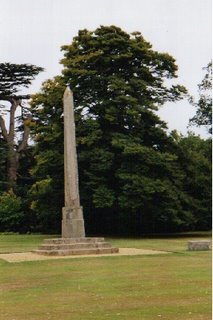
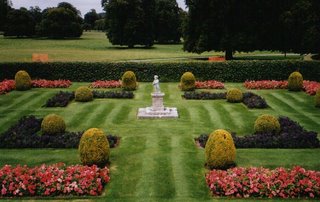
In the gardens we we found an obelisk and sarcophagus stolen from Egyptian sands and many pathways.

  The paths in one section were so well set up for enjoying each others company that they must have been designed with that in mind. Though how they managed to get up those in victorian skirts is beyond me. Necessity is (I suppose) the mother of invention.
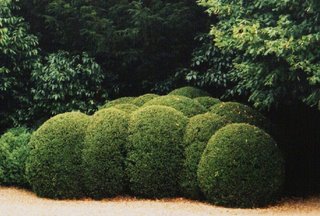
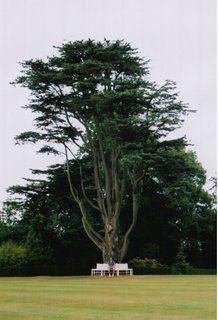
I have come to believe that the world needs an aristocracy so that people will sponsor the beautiful things. I only hope to be one of them!!!
However, still a member of the plebian class I , with my paramour, returned to the campsite for our much anticipated dip. The water was warm, at least a good half degree above freezing, and my insane wife plunged in head first while I waded in with trepidation. We enjoyed the water, cold as it was, until freezing temperatures drove us to the warmth of our tent.
Next Entry: Day 31. Holbury
Previous Entry: Day 29. Wimbourne

Wednesday, August 24, 2011

Day 18. Chepstow August 24 2001

For some reason today was very difficult, my legs seemed like leaden weights and it felt like some malicious entity has stuffed chunks of masonry into my panniers while I slept.

We woke in St. Briavel Castle after hardly sleeping at all. It truly felt as thought I had slept in prison, fellow prisoners snores and all. It did not, I’m afraid, help my mood that the toilets only worked sporadically.

When finally Heather and I were able to move enough to push our bikes, she having slept as well as I, we plunged down once more into the Wye Vally. It had rained in the early hours of the morning and the valley floor was shrouded by a thick mist.

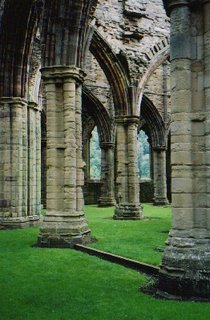
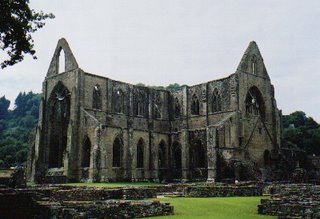
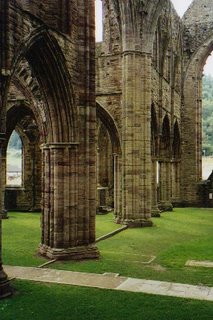
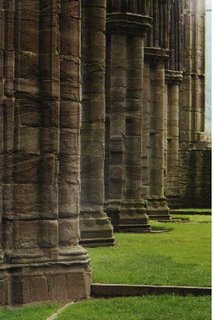
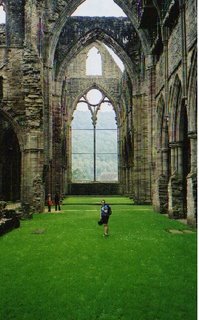
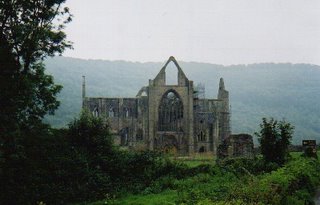
Our first stop today was at the ruin of Tintern abbey, a Cistercian stronghold that had been abandoned after Henry VIII’s dissolution of the monasteries.


The abbey was a ghostly skeleton on the valley floor, great arches gaping blankly at the sky, grass growing wild in the halls of its monumental structure.

It was like touring the remains of some ancient antediluvian beast that had been washed ashore and gnawed at by the birds for eons uncounted.


When we sat in its tumbled stones I could almost hear the forgotten generations of the faithful as they walked the ruins. It was a humbling experience.

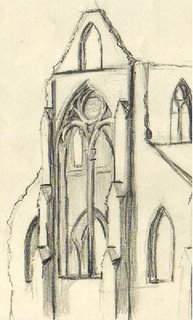
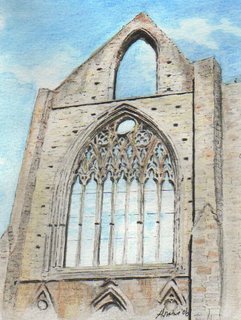
Heather was enchanted with the abbeys ruins and strove to capture its elusive essence with pencil and paper. Her frustration with her lack of ability is, to put it mildly, unfounded.

From the abbey we had a harrowing ride to Chepstow, my muscles strangely falling apart. When finally we crested a hill and saw blue water before us I wanted to shout in exultation “The Sea, The Sea” but it is only the tidal mouth of the Severn River and unlike Xenophon and his ten thousand it does not spell escape for us but an upward climb we are scarce able to handle.

We found our campsite with the gratitude only the truly exhausted can feel only to find that it is the beginning of a holiday weekend and the Brits have swarmed out of their cities in droves. We were stuffed in today but the rest of the weekend will be a challenge. It is selfish I know, but I sometimes wish we were the only tourists. Imagine Tintern alone!


Next Entry: Day 19. Bristol
Previous Entry: Day 17

Sunday, August 14, 2011

Day 8 August 14 2001

The day of setting out on our own rushes towards us. We thought to begin some preparation today but got a little sidetracked.

We went to Shrewsbury, to the Kings Head pub, a beautiful ancient place jutting out into the streets, where we met Rick Phillips, the man who had catered our dinner. We have been so lucky in our friends here. All of them have been wonderful beyond belief.

Across the street at J.C. Pickering Toy Store we did our only real bike related thing, we found Heather a headlamp for her bike. It was a quaint toy shop filled with wondrous toys and an antique old man running it without recourse to electronics and quietly mourning his lack of sons to whom he could pass on his business.

From downtown Shrewsbury we meandered along a strange route, chosen by my father, who refuses to believe he is going in the wrong direction. Hence we were privileged to see new parts of Shrewsbury; the wealthy quarter, the prison; the toll bridge in the center of town...

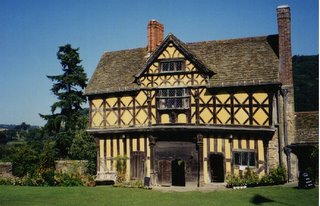
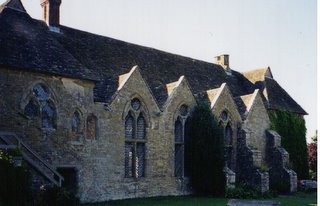
Finally we found our road and made our way out of town towards Stokesay Castle. We had picked Audrey and Den’s grandchildren up from a vacation bible school earlier and so they accompanied us. Stokesay is a gorgeous old structure, unable to decide whether to be a large house or small castle.
I managed to find it's beauty in the strangest out of the way places: the remnant circles left by ancient barrels in the storehouse, the back of the slate roof, the wooden pegs on the wooden slats that had shelted Stokesay’s owners for unknown years.
The boys, Sam and Tom Phillips, bought wooden swords as though Stokesay had played an important part in bygone wars instead of surrendering immediately the only time it was confronted with hostility.

Eventually we came back to Parkgate and sat down for dinner, followed by a lively discussion on the merits of hereditary authority. Before bed Heather and I were treated to a viewing of Dennis’s paintings.


Next Entry: Day 9
Previous Entry: Day 7