Showing posts with label Rain. Show all posts

Tuesday, November 08, 2011

Day 94. Gradignon. Nov 8 2001.

A rainy day at home, doing preparations of our train trip to Avignon. A respite from racing around the narrow streets of Bordeaux and a chance to catch up on writing.

There was such a flurry of things that passed us by in the last few days that I was bound the miss a few. Most glaring among the omissions were the plethora of names left from my list of famous painters who failed to make much of an impression on me.

There was a painting by Van Dyck, one by Rubens, Chardin, Van Gogh, so many that they were beginning to flow like water.

Delacroix’sLa Grece Sur Les Ruins De Missolonghi" was stunning and powerful and if it had been in a room alone or with two or three other paintings, each chosen specifically to highlight one another it would stop you in your tracks and force you to explore the visual details for hours. But here, mounted with a hundred other paintings it became nothing more than wallpaper. Nice wallpaper, but but wallpaper nonetheless.

I can't remember if I wrote about the statues lining the entire second wing and I am too lazy to check so I will, perhaps, repeat myself. Only three in particular caught my attention of which I know the title of one and none of the artists. The one whose title I remember was “La Garonne” an allegorical representation of the river Bordeaux faces. It was a bronze of a woman reclining in a flow of water, leaning so far back she is almost lost in the waters. On either side of the flowing water is shore composed entirely of grapes.

It was beautiful but that was not what caught my attention. The piece seemed composed entirely, I’m sure not by the artist's original intention, of irony. Nowhere along the Garonne had we seen anything to evoke beauty or tranquility. Instead the river was a churning mud mess with the detritus of a thousand kilometers choking the banks and spilling out to smash against the docks of the city. Perhaps the artist was thinking somewhere upstream.

The other two that caught my eye seemed to belong to a set. They were statues of women out of marble that had obviously been outside for a very long time. They were weathered and scratched were vandals had gotten to them. One was of a young woman with the idealized body of womanhood, large breasts but perky in defiance of gravity, thin waist, well muscles arms and legs, almost a doll-like form.

The second was a woman, still beautiful, but now with a form that was humanly possible to achive. Full breasts that curved lower across her chest, a more curvaceous figure, fuller but more sensual, less heavily muscled. The pair seemed to show the ideal of beauty and the reality of beauty.

The Museum of Aquitaine, from the day before, had many exciting works of art, many pieces that seemed to capture the feeling of an era, and they were displayed exceptionally well.

The remains of Roman statues, often only the chest and stubs of neck, arms and legs, had lights trained on them to give them a unique glow, or were mounted against a red wall to contrast with the white pallor of the statues. The most impressive piece in the collection was the bronze figure of Hercules striding purposefully through the room. His face seemed so alive that his sightless eye sockets evoked a sense of pity and dismay at the blinding of such a powerful figure.

Many of the Museum's Gallo-Roman pieces had come as the city was excavated to make way for new buildings. One particularly rich source were the excavations for a supermarket's parking lot. Interestingly, since the supermarket was destroying old buildings to get their parking spaces the city of Bordeaux forced them to preserve the facades, so now shoppers park behind 18th century homes.

Another portion of the museum that really caught my attention was the few model ships on display, although by the time we saw them we were hurrying through the museum to see as much as possible before it closed. There is something so intricate in the workings of a model ship. Even thought they can reach enormous size the detail is amazing and the knowledge required phenomenal. I remember at the naval history museum in Southampton they had displayed the bone model ships made by the French prisoners of war and the guest book had commented derogatorily about the lack of correct detail. You had to ask if the people writing the comments could have done better. It would be fun to make model ships, but there is something infinitely sad about a person making models of ships when they live twelve hours away from the ocean.

Today the rain had mingled with the cold to become a real danger. The water runs through the rocks like the beginnings of a river and though our belongings are wrapped in plastic they are beginning to get wet as the water seeps upward. Somehow the waterproof groundsheet of our fabric home has become waterproof no longer and the spreading stains of the damp congeal into puddles within our tent as we watch, as if the water is willfully forcing its way through the plastic.

I peer outside and see a torrent of water that streams down the gravel road of the campsite. Rain in November is new for us and I can see suddenly why the world sneers at the idea of warmth in Canada. For Calgarians the best we could expect in November is clear skies, the worst, heavy snow. Never rain.

I am reminded of our trip to Prince Rupert where we were almost rained out completely. Yet it was a very rewarding trip. Not so much in the conventional fashion of most vacation, but because it revealed so much about the inner workings of our vast country and the diversity of the people who call it home. The Tsimshian people were so proud of their heritage and their homeland was so beautiful. Deep fjords, misty islands and rain drenched forests.

Somehow I am back on the topic of rain. It will be, I fear, a dominant theme.

We stopped the other day, on our way back from grocery shopping, at the ruins of a wine making estate on the road towards our campground. There was a twelfth century church and an old estate home, both closed to the casual tourist such as we. But the garden was magnificent, overreaching green trees making a ceiling of foliage, only a few leaves clustered on the ground dropped from their lofty perch. There was a pathway of concentric arcs through the green grass and it was lined with flowers of all description, still in bloom. While we stood there the cold chased at us through our jackets and sweaters, chilling skin and making us long for warm soup but it left everything around us untouched. It was as if the cold taunted us and made us imagine that the cold was only in our heads. the beauty made it seem that we are trying to flee a phantom that cannot harm us. But the rain that beats a staccato rhythm on our huddled shelters is real, it has an icy grip and we have to try and get from beneath it, at least for a while.

Bordeaux, despite it’s generous museums and hidden beauty has been a disappointment. The grandeur here has faded beneath a veneer of indifference. You can still see the magnificence, like a beautiful painting left in a puddle of mud at the roadside, but its faint manifestations are almost sad. I know that we have not been charitable to the city, nor credited its successes, the museums and the shopping district, enough. But when cities that boast only half the population, or even less, seem to make more of an effort to show what little beauty they are gifted with and seemed to take so much more pride in their patrimony, you are little inclined to be charitable.

Or perhaps you cannot blame cities but must look more to the individual. Even in Saintes there were those who treated crypts as garbage cans, in La Rochelle those who pissed on the street. There is always a certain percentage who do not give a damn for beauty or heritage.

I cannot help but feel pity for those who strive so hard to make their city beautiful and are defeated by an uncaring few. It only takes a few to ruin it for the many. Michelangelo’s Pieta was wrecked by one crazed man.

At least the people seem to have been very friendly particularly our ticket agent and the guy at the museum. Friendliness makes up for a lot but not the tons of dog shit and not, for us, the rain.

Next Entry: Day 95. Nimes
Previous Entry: Day 93. Bordeaux

Monday, October 24, 2011

Day 79. Marans. Oct 24 2001.

I woke today from the best sleep I've had in a while, since well before this trip. The greatest gift a person can have is the gift of perfect sleep. What I woke to was less encouraging. A storm raged outside our window. Sheets of rain pounding on terra cotta rooftops and lightning igniting the walls of our room in arcs of electric blue to be followed by a thunderous boom that made the panels of our ancient dresser rattle like old bones. It was beautiful to behold, all the more so behind solid walls around which we could hear the howl of the wind and not feel it.

I listened to the storm for a time that seemed almost frozen, wrapped in warm blankets next to my sleeping wife, listening to a downpour of water that a few nights before would have sent me scrambling for earplugs and something to block the single leaky Velcro strap at the top of the tent. I tried to figure the time from the depths of the darkness at the window and calculated it to be three or four in the morning, plenty of time to slip back beneath the warm covers ands regain my beautiful sleep…and the alarm went off!

We rose and dressed with languid disregard for the time, despite the long distance to be covered. We had no desire to leave. Eventually, despite our reluctance, we slowly filtered down the wooden stairs, paid for our lodgings and got our bikes from the filthy garage. The rain still dripped periodically as we loaded our luggage and as we set out, making us none too eager for the road.

We cycled listlessly at first, as if by leaving half heartedly we could preserve the comfort of the room behind us. But the sun soon came out, driving the rain away and our strength picked up in an old familiar rhythm.

We had not gone long before I noticed a strange grey shape. Unexpectedly a menhir loomed into view, an ancient site marking…what? We cycled in close. An old, obviously seldom used, gravel path led out to the menhir. The menhir was somehow beautiful in its ugliness, standing upright in a circle of red gravel ten feet beyond where the path gave out.

It rose grey and monolithic to the sky, which changed from white to blue as we watched in awe. The lichen crusted skin only added to the surreal atmosphere of the stone. Standing not a hundred yards from a major highway we were transported to another, far older, world.


Then we noticed huddling in the shadow of the menhir before us a second, smaller, stone, the second point in a broken triangle. They were the Menhirs of Plessis, all that remained of an equilateral triangle of stone raised before the conquest by Rome. One, the first, rose seven and a half meters while the second squatted toad-like at a mere 3 and a half. The third had been destroyed in some unnamed accident almost a hundred and fifty years ago.

Ironically enough a modern power line ran nearby, as if mocking the ley lines that some believe were marked by the menhirs.

Returning to the road was almost like time travel, rejoining the century we had left behind, cars rushing heedlessly forward while the rocks stayed, silent and unchanging. The trucks honk again as they pass us and we have reached a new conclusion. They are honking even as they cross over into another lane to give us as wide a berth as possible. It is possible they are not honking angrily at us to get off their road but instead giving us ample warning so we will not be shocked as they barrel by or so we won’t be caught in the current of wind they pull behind them like the wake of a ship. It is preferable to think that they are being kind whatever the case may be.

We continued on and welcomed the arrival of flatter country. The sea was still some distance away but the terrain was flat, the wind was at our backs and we arrived at our halfway point of Lucon far earlier than we had expected. We bought lunch and cycled to the cathedral to eat.

From the outside I must say that Notre Dame de Lucon was very ugly indeed. There was a fine facing and large gothic windows, a series of rising Doric, Ionic and Corinthian columns and a spire that looked as though it could touch the clouds. But generations of rain and wind had worn delicate carving to nothing and years of neglect had eroded any beauty to a hideous mockery of it’s former self, like an old hag who can see echoes of the beauty she once was in the wrinkles of her face. There was little to entice us in. Even the monastery rose like an ancient growth from the cathedrals side, its conglomeration of architectural styles more like a cluster of cancerous cells than a thing of beauty. But we went in, more to find shelter from the cold breeze that had sprung up than from anything else.


Inside lived up to our expectation and yet did not. It was ugly, falling apart in a fashion that makes the word dilapidated kind. But every niche was full. There were statues of St. Joseph, Christ and Joan of Arc. There were paintings; Christ on the cross, our lady of Lourdes, a dozen others. There were also marble testimonials to cures or prayers granted. All this transformed a decayed look to a lived in look, from dead to well used. This was the first church in which I had seen testimonials to St. Joseph for his intervention. Mary gets all the press.

We found the door to the cloisters and filled out in silence. The cloister was almost flooded in the middle. Last nights rain too much for the medieval structure. But it was from here that the cathedral looked best, its spire echoed many time over in points rising above each stained glass window.

We returned and discovered the cathedrals pride and joy; an ancient lectern, colours fading, from which Cardinal Richelieu had preached between 1606 and 1623, his years as bishop of Lucon.

 
Turning back we saw Lucon's second pride, a great pipe organ, a gift from Napolean III, rising like a curtain of silver, filled the back of the cathedral. One could only reach it on a bridge from the monastery.

Outside the day had turned colder, more than once I have been tempted to steal candles from a church, but we set out none the less. We had entered the region of the wetlands, a flat stretch of France in the grassy armpit beneath the peninsula of Brittany and the Pays du Loire. It was flat and so we liked it but the wind was harsh. Heather rode before me, her bike tilted at a constant pitch of 5 of 10 degrees just to match the wind. Everywhere were massive fetid channels into which the marsh drained, channels that flowed with the speed of sludge towards an eventual rendezvous with sea. Cows stood at the edge of the canals and stared forlornly across, as though the draining of the marches had happened overnight, leaving them trapped on islands that they could not understand.

Marans was one, actually a series of many, such islands, titleling itself “The Green Venice.” Better than “The City With Sewers that Never Drain.” The place where we pitched our tent was so damp and muddy that I was ready to believe the cows; the marches had only been drained yesterday. The host at the campground was very excited to see us. He ran out from where he was helping city workers dig up the water mains and talked to us most excitedly in English. He followed us around our site giving a running commentary on our fellow campers and even looked ready to pitch our tent with us. I followed him back to his office to talk to him.

He was enthusiastically helpful, calling ahead to campgrounds he thought would be open and fuming angrily at the phone when no one answered. He was very vocal. I showed him my Michelin guide to camping and he snorted “Oh, it is shit!” I asked him about the work being done at the campground and he said “Oh, those government guys, they are shit!” He wanted to talk about the weather and said “Oh, it is shit!” Finally he told me that he had to go, he was meeting with a government minister about getting the work done. “Oh,” he said “He is an asshole.” I can guess which first words he learns in any foreign language.

Setting up tent was a strange and unsettling experience. After all the effort cleaning it sinking our fabric home into a hillside of mud seemed almost like a desecration. A small canal ran just behind our tent, a thick soupy green, and it was hard to believe that it was not more solid than the slippery ground beneath us. Our tent pegs sunk in so easily they almost disappeared beneath the earth and when we sat down on our sleeping bags the ground shifted around like a waterbed beneath our bodies. At least it was comfortable, but I miss the solidity of four wooden walls and the convenience of a shower in the room. One stop at a hotel and you’re ruined.


Next Entry: Day 80. La Rochelle
Previous Entry: Day 78. Talmont St. Hilaire

Friday, October 21, 2011

Day 76. Talmont St. Hilaire. Oct 21 2001.

We woke to misery. The tent was coated in a thick layer of sand, the sky was gray and water had seeped in through the corners. Both of us were ill, Heather worse than I, but we were equally wracked with coughs we thought would have left by now and Heather was congested enough that her head ached.

To leave or not to leave was the question that plagued us. I wanted to go, Heather wanted to stay. I felt a need to leave this campground with its sandy plots and rattle of dead branches against one another. Heather wanted to stay, looking at the gray sky with a weary eye, not willing to deal with another day of rain. Finally I prevailed and had begun to load my bike when the clouds opened in a downpour that left me soaking.

We agreed to stay.

But time passed and while the clouds did not lift they lightened and I argued to go once more. Our destination town was not far and I wanted to be on the move. Finally Heather capitulated and we packed up once more, fearfully watching the skies. Even as we worked the clouds blew over and revealed beautiful blue sky and brilliant sunlight that shone down like a benediction.

Still, packing was not easy. Cleaning the tent of the grime and sand splashed on by last nights storm proved impossible. We were forced to give up and we packed our filthy dwelling away angrily. We rode out into perfect sunlight looked forward with an optimism that was misguided, if not foolish. Because it was Sunday all the stores were closed and we had no food. The lady at the counter of our campsite reassured us that there was a large supermarket nearby, ready to cater to our nutritional needs. But when we found it even the McDonalds in the parking lot was closed. We had little choice, today we would eat short rations, finishing off the leftover peanuts and hoping for a quick dawn tomorrow.

We headed east, leaving the ocean behind, but not the ominous gray clouds that peered over the horizon like a rising swell of waves. The gray became dark and black and the clouds swelled with a heavy weight of water until they could hold back no more and burst open in anger. We were caught almost halfway to our goal and were soaked to the skin once more. The clouds parted as swiftly as they had gathered but the suns feeble light did little to dry us.

We reached Talmont sometime in mid-afternoon. Even the restaurants and bakeries were closed and there was no sigh of the promised campsite. Finally we found a clue and headed back out of town.

We found the campground alright, the one our guide promised “open to the end of October” and once more it was closed! I stared at the “ferme” sign and felt anger boil inside of me. How can you plan a trip if your guides are full of faulty information? How many more time would we face the gut wrenching disappointment of “ferme” and feel the stress of not knowing where to sleep? My anger hit a critical juncture and I flung the book from me in disgust. Three hundred and sixty degrees from which to choose and unerringly I hit upon the ten degrees that are occupied by my distraught wife. The book bounced off the front of her bike and my anger dissolved into depressed apologies. It felt like I couldn't even get angry without screwing up.

Despondently we headed back to Talmont facing the inevitable fact that we had to break the budget once more and find a hotel. We had not lost all our spirit however and decided that a two star hotel was better than a no star hotel and hence we followed the signs out of town. What the signs failed to mention was that the two star hotel was in fact on the beach, a good thirty kilometers or so from Talmont. We gave up in despair once more.

We returned to town for our third time and sought the low budget places in the crowded streets. The first, catering to truckers, had a huge sign hidden on a back window, closed until October 29. The second didn't even bother with a sign and was merely closed. Mere words cannot convey the cold numbness that had dropped over us. We stood listlessly in the street, listening indifferently to the silence of the city. Even simple decisions became impossible to make. How could we make another when all the others had turned out so wrong?

Finally our aimless and careless wanders brought us to the Boule D’or, a restaurant with lodgings over top. I went in to ask, not even caring anymore what the reply would be. The young woman at the counter seemed surprised that she had a tenant and showed me the room with an apprehension that could have been fear, excitement or surprise. The room was small and I didn't really see it, didn't really care. I went down to Heather and we stowed our bikes in the filthy garage. We climbed the steps wearily.

The room was a square covered in white wallpaper with blue splashes and water stains near the ceiling. A yellow bed with a fold in the middle large enough to hide a person stuck out in garish repose from the rotten wall, beside it an old beaten wardrobe. On the east wall, where a window looked out to the back roof of the restaurant and a panoramic view of lichen covered roof tiles, was a single wooden table and a single wooden chair from which I am writing even now. The south wall sported a sink that hung loosely from the wall over orange tiles that covered the hardwood flood. Beside it was a booth two thirds the size of a phone booth, in which we could shower. Our toilet was down the hall, with no sink of its own.

Despite the crudity of the room it somehow added up to more than the sum of its parts. I could picture myself huddled over the skeletal table, beside the window that looked on nothing, scribbling madly with pen in hand, the very posture from which I write these words.

The room had, has, an ambiance that brings to mind lonely struggling authors, painters, artists of all stripes and the frantic need to create that can tolerate no distraction. Even the church bells sound sweeter from here, more real and relevant to the passage of human time. But ambiance and peanuts a poor meal make and I was getting more ill with every clang of the bells.

As night fell we went in search of a pizzeria that we had passed earlier. San Marco’s was a small dive with mural of Venice covering one wall, yellowed from cigarettes and age. The pizza was excellent. The pepper oil served in a long tapering beaker with the leaves and peppers floating in a golden soup with a taste that burned lips and tongues and left you wanting more. San Marco on the Avenue of the Sands. Our server was young and polite, as all those who want to be elsewhere but know you are their paycheck can be. His mother bustled about warning us to be careful of the spicy oils, watching with delight as we ate our first ice cream in months and running around with a happy smile and familiarity that made the restaurant her own. Even flustered as she was, trying to use their new, intricate, credit card machine, she never lost a brilliant smile. We left reluctantly, our bellies hardly full, the smoke from fellow dinners burning my lungs and forcing long painful coughs from me that tore at my throat.

As we climbed the stairs to our room Heather noted a strange light at the hallways end. She looked out and gasped. The fortress of Richard the Lionhearted, the centerpiece of Talmont St. Hilaire, was bathed in a gentle blue glow, as if rising from an ethereal mist. The church that rose beside it blotted from view.

We had visited the church earlier, after we deposited our gear and gained some volition back. We had sat in the pews of St. Peters and talked seriously about the future of the trip. With campgrounds unexpectedly closed at every turn and both of us so ill that we can hardly bike, let alone clamber over ruins and tourist sites, our future is hazy. I have no desire to end the trip, but our budget will not allow many stays like tonight's. I despair a little, feeling as though we have failed in some esoteric fashion. We have seen so much and yet so little. But tonight at least I am too ill to contemplate going on.

I cannot help but feel like a pale shadow of Keats, with my tiny room, wracking cough and despair. But I am not dying, I am not a poet and I have the hope at least that in the morning my despair will be gone. At least our walls do not shake tonight as I cough and I can sit up by electric candlelight. Darkness outside with light inside is strange to us and looking at the clock I see that it is almost 9:00. An hour past our bedtime.


Next Entry: Day 77. Talmont St. Hilaire
Previous Entry: Day 75. Les Sables D'Olonne

Thursday, October 20, 2011

Day 75. Les Sables D’Olonne. Oct 20 2010.

Woke up this morning to a perfect day. I only wish that they’d stay like that.

We packed up quickly, after eating breakfast in our tent and trying to convince the farm dog that we had nothing appetizing for him. Neither of us mentioned the weather in the hope that it would remain bright and blue. Off in the distance we could hear the turkey gobbling. He was enormous and on coming in the night before we had been more afraid of him than the energetic dogs. The chickens had seemed a little abnormal as well, they had a huge spread of feathers on their legs that made them look as thought they were wearing bell bottom pants. What with the turkey’s huge fan of feathers and one of the dog’s shaggy beard it was a very fashionable farm.

I had slept well despite the downpour and the ridge of dirt that ran directly under my shoulders.
Mounting our bikes in the morning has become an art of compromise. We know that we must get moving but we are reluctant to begin the never ending effort and the sawing pain of insufficient padding. Generally, by unspoken agreement, the bikes are walked to the entrance of the site. When we finally climb our steeds of aluminum we try to avoid sitting for as long as possible. Today was no different and setting out was harder than usual because we had to face the one task we hated above all else, retracing our steps. Back we went, following last nights hard road, past the abandoned campground and past the turn to the lake.

Finally we found new ground and we headed towards Les Sables D’Olonne. Today the transformation in architectural styles is almost complete. Gone are the stone and brick houses with slate or shingle roofs. Every house here has whitewashed walls, terra cotta shingling and, more often than not, blue shutters on the windows. Before we had biked too far we came within sight of the Atlantic Ocean. Sea breezes caressed our faces once more. The houses look perfect nestled against the distant band of blue on the horizon. Design elements in the plan of an artist who has sculpted the world. The ocean has become our ally and our nemesis. The land near it runs in long flat strips, where we can see almost to eternity and worry not about what comes after a downhill ride. There are no downhill rides except to the water. But the sea breathes and its breath is a wind against which we are locked in terrible conflict. Every gust is our foe and every calm merely a pause in the struggle.

Soon the sea was lost to us once more, hidden behind the shelter of the island of Olonne. We cycled over a thin strip of pavement perching precariously over marshlands that stretched as far as the eye could see. There was an air of abandonment and decay here, a basketball court so overgrown with weeds that only the rotting backboard and iron hoop from a long vanished net spoke to its original purpose. The whitewash on houses cracked and fell to the ground in faint speckles as if snow had come too early. Pornographic posters, elsewhere left alone as if not worthy of notice, were blacked out in reactionary anger, only to be replaced by more until they papered over the landscape. In the distance a spire rose on a rocky hill above the marshes. Our goal, we though, until we reached it and another rose behind it.

Les Sables D’Olonne sat along a whaleback ridge at the marshes edge, separating wetland from ocean. We cycled in and were surrounded by urbanity once more. Urbanity in this case most obviously exemplified by the motorists who tried to run me over as I crossed the street, despite the light being in my favor.

The foliage was brilliant and verdant and I thought to myself how nice it was to be in the middle of October and see green trees. We found our campsite with little difficulty and simultaneously discovered the one place in town where no leaves, not a one, were left. All the trees were bare and most, I am sure, were dead. The broken wreckage of their limbs littered the grounds, filling the sites with the debris and detritus of approaching winter. We found a site clear of branches, not yet transfigured into a pit of slime from the terrible downpour of the night before and we pitched out ten on the sands beneath the twisted cedars.

We had made good time; it was scarcely past noon, and many hours of daylight lay before us. We stretched out our sleeping bags on a line, trying to let their smell dissipate before we crowded into them once more. While we waited we used the parks glass shrouded phone booth and made contact with those we left behind. They were well, Dad had just returned from his excursion to Halifax and was very excited about his new photos. We spoke for a long time, sharing news across countless miles of ocean and land.

On our side a storm began brewing and Heather raced off to pull our things down from the line. I finished talking and followed after her, arriving at the tent as the big drops began to fall. We huddled under our waterproof shelter and listened to the shower, the winds and the sound of the water trickling. At this last we sat up and noticed a small river forming under the tent and others to the side. Heedless of the freezing rain around us we leapt up and hurried out of our small shelter. The sand around us was pockmarked with a million pinhole craters, shifting and reforming under the bombardment of water from the heavens. We hurried to fill the trenches around our tent, trying to stem the surging rivers. The ground was saturated with water and would take no more and all the overflow seemed bent on filling our tent. We managed to fill in the area around our tent with makeshift sandy dikes. We hurried into the protective shelter once more, only to have the rain stop completely.

Heather is sick tonight, still, and I cannot seem to shake this cough that wracks my body from time to time. Whether we are truly ill or merely allergic to our surroundings, our tent, our sleeping bags, each other or ourselves, is a frequent topic of discussion. I must admit that we are both feeling melancholy tonight and the subject of our date to return home was the primary topic of conversation. Both of us are missing the comforts of home but leaving would mean an end to our journey and a return to normalcy. That would be, to put the best possible spin on it, anticlimactic.

Our spirits were lightened somewhat by the camp's cat. It rummaged through our garbage, hoping no doubt to find the sausage that we ate for dinner. We shoved the cat away but it was brazen enough to return eventually, near midnight. It grew willful enough to steal our garbage out from under my watchful eyes.


Next Entry: Say 76. Talmont St. Hilaire
Previous Entry: Day 74. Coex

Monday, October 17, 2011

Day 72. Nantes Oct 17 2001.

A day of rest before the big push out of here.

It occurs to me how much I have left out in my accounts of Nantes and thought to record a little of it on this day of doing little.

Like how the day before last we went to the little Island of Versailles in the Erdre River and walked through a Japanese style garden in the setting sun, then through a Japanese style building filled with aquariums displaying the aquatic life of the Erdre.

We walked through slowly, enjoying the tranquility after a long day running around. We ate bananas and listened to a small French boy running frantically through the displays yelling “Vache, Vache!” as he tried to find the model cow that mooed every once in awhile. I don’t think he believed such a loud noise could come from such a small model and he was desperate to find the real cow that must be hidden somewhere in the large building. We ran into his embarrassed mother on the way out.

I see too that I have left out the fact that the street in from of our tent door seems to be a major meeting point for some of the male inmates of the campground. As far as we can determine they live full time in the little tents that surround our site. I found it hard to believe at first, most of the tents are, if anything, even smaller than ours and ours is none too big. They spend most of their time in big groups or in the washroom. At first it was disconcerting to always find them in the washroom but now I am convinced that they are simply longing for solid walls around them for some of the time. They seem to be French Arabs, so I am guessing that they are Algerian, a fact which is pure speculation on my part.

I notice as well that I have left out descriptions of most of the Dobree museum. When I see a place full of beauty I worry that I will run out of space and so describe it only generalities, then find myself with extra space left over. So I will describe a few treasures now. There was the pin in the jewelry collection that stood out, blue knot work in something like enamel. The sides were bordered in glimmering silver and the spaces between the knots filled with pearls and semi-precious stones. I cannot help but wonder what Heather sees when she looks at such a thing. I see a beautiful whole, a piece of jewelry but not much more. She must see the hours of painstaking work that created the piece, the art and the learning behind it.

Another big item in the Dobree museum that deserves description is the anniversary chest from the 17th century. A chest of drawers that folded out into three panels with stunningly elaborate drawings on the two folded out panels and a series of drawers in the center. The left panel held a painting of Constantine at the battle of the Milvian Bridge. The right was a painting of St. Louis, King of France and his marriage to someone whose name we have both forgotten. Each drawer in the center was decorated with a beautiful painting depicting a pious event in the life of a French king. At the bottom was a small slide out table. The wood was a dark mahogany and the whole thing exuded tranquility and peacefulness that no mere object should have. It was very beautiful and had only recently been restored to its original condition. It had pride of place in its own exhibition, in an alcove near the stairs on the second floor.

The final thing left to describe in the Dobree was the rather unique collection of medieval sablieres, I don’t know the English translation for them. They are the pieces of wood that line and important transition part of a structure. The ones in the Dobree collection were intricately carved with faces, each grimacing in some bizarre fashion at the face next to it, sticking fingers that appeared out of nowhere up noses and into ears, stretching lips apart to make inaudible rude noises or to stretch out an impossible long tongue. Heather particularly enjoyed one carving, of the way a woman prepares her husbands dinner. It was a grotesque carving of a woman peeing into a pot while her husband waited hungrily in the next room. Some people are really sick.

Today itself has been relatively uneventful. The only big ticket item on the agenda was getting our laundry done. Doing laundry in France is expensive, in the way that buying new clothes at home would be expensive. We wash things by hand but then we are reliant on the weather to dry things and "weather" and "reliant" are words that mix like oil and water. My hands are calloused from incessant wringing and my biceps are stronger than they have ever been. Forget expensive gyms and personal trainers, forget buying a washing machine and dryer, simply combine the two and save money.

We are trying to clears things out of our tent in preparation for tomorrow. Everywhere we stop we accumulate things, especially pamphlets on the region, and they get cluttered around the inside of the tent. We are trying to be like the proverbial rolling stone, but a lot of little nooks and crannies offer places for moss to grow and when we try to shake it free we only create chaos for ourselves.

It will be hard to leave Nantes. For the last part of the trip we have had immediate, nearby, goals. Cherbourg to St. Michel’s, St. Michel’s to Rennes, Rennes to Nantes. But now our next stop is essentially Bordeaux. It is almost as though we are following a track that has disappeared. We are going to follow a line made by connecting the dots of open campgrounds. It will take us out of our way but it will be easier and more certain.
I think.

Clouds are rolling in tonight, endangering our fresh laundry. Even as we pull in the clothes the clouds break and a storm dumps down. For the first time lightning lights the sky. At first we wait for the flash with a kind of wonder, but it soon draws neared, until the clap of thunder seems to come a split second before the flash and all the lights in the city blink out in sympathy.

Then we pull the comforting hoods of our sleeping bags over our heads and bury ourselves in warmth and security and a smell we will have to wash out soon.

Next Entry: Day 73. St. Etienne Du Bois
Previous Entry: Day 71. Nantes

Saturday, October 15, 2011

Day 70. Nantes. Oct 15 2001.

We woke up today to a beautiful blue sky, no rain clouds in sight. I turned to Heather and said “look, blue sky” and rain clouds rolled in and opened up. Never, ever, ever, comment favorably about the weather!

But after a day inside yesterday we were definitely going to explore Nantes. First on our list: La Musee des Beaux Arts and the Picasso Exhibition. We had not expected the school children! We walked the distance to the museum and even followed one of the classes as they marched resolutely to the entrance. But the museum was still closed when we got there and stairs were crowded with youngsters so we decided to walk around the building first.

To the side we found broken stone sculptures, as if they had been cast out the back door to crumble and rot as mold and greenery ate them away. One was a mother and child, her arms shattered by an ancient calamity, so her babe hung precariously on her knee. The other was an angel, buffeted in the wind, his arm severed at the shoulder in a ragged stump. We returned to the front to find that the children had not dispersed but that the doors were open. We waded through a sea of young faces to buy our tickets.

Our first stop was the main display, Picasso La Peinture Seule, a series of works that had not been displayed since just after his death, the works from the final decade of his life. Picassos’ work, for me at least, is a strange mixture of perfection and grabage. His was a lifelong struggle to find beauty without form, an ideal that he reaches only rarely, one painting out of every hundred. To convey the feeling of a thing, a place, a person, without recourse to the fragile shell that makes its form, is to understand it as well as its creator, and that is a gift handed out parsimoniously.

It seems like Picasso found that ideal once, in a painting from his youth, and spent the rest of his life trying to find it again, his few successes only spurring him to try all the more desperately. Perhaps that accounts for his prolific collection. So many works, so few successes, but those spectacular.

Even more interesting than the works of Picasso was watching the desperation of the teachers as they tried to explain to their classes of eight year olds what his work meant, why he was such a force in the art world and what, exactly, that man in that painting was doing to those women. To their credit the teachers were a lot less flustered than any adult in North America would be in such a situation. They told the children that the couples were making love and left it at that. Our museums would, I think, just ban those paintings.

We left the main floor and climbed to the displays above, surrounding the museums central court. Here we found classics paintings mixed with an exhibit called The Uninterrupted Dialogue. The classics paintings were good. I enjoyed a scene of the eruption of Vesuvius; in fact I enjoyed all the ones that referred to classical myth or history. There was a piece called “The Aftermath of Lucretia’s Rape” where Rome was about to become a Republic that I enjoyed. Also memorable was a composition that was an allegory for the Parisian school of fine arts.

The detail in the women representing Gothic Art and the Art of the Renaissance, respectively, was magnificent and they seemed to shimmer with an internal light. The artist had done a smaller study of them, along with some priests from the main image, and they seemed almost alive.


Paul Delaroche was the artist.
But by far my favorite, and I think Heather’s as well, was “Jeune Fille” by Hippolyte Flandrin. It was a painting of a young woman with downcast eyes, coy and seductive. It was enthralling.
One other painting in the museum really stood out for me, in both a positive and negative fashion. “The Deluge” was an amazing painting, capturing the desperation of those last left alive during the biblical flood. An amazing painting that captured the suffering and the anguish. It also raised the question “How can God claim to be compassionate and yet do this?” A truly awe inspiring piece.

But it was also part of the Museums “Uninterrupted Dialogue” show. The show was meant to show older works reinterpreted through modern eyes and was quite successful. The old must constantly be re-evaluated in the context of the new or it becomes irrelevant. But the “artist” who reinterpreted "The Deluge" had draped the painting with netting filled with stuffed animals, almost totally obscuring the original painting. We only saw the original in a photograph hung next to the work.

Covering and obscuring the work of another artist, in the interests of promoting your own work, seems like one of the most obscene acts an artist can commit. The modern "artist" had a screed posted with the works denouncing the use of nude women in the painting, ignoring the naked men alongside them I suppose. She claimed to be obscuring the original in the name of feminists everywhere, doing more damage than good from my perspective.

We left the musem and went to the nearby Jardin Des Plants, a beautifully manicured garden, to discuss art and feminist theory and feelings without form. We meandered through patterned lawns, past trees and monuments to Jules Verne, and left finding our thoughts in close accord.


We went through the St. Peter gate and entered the St. Peter and St. Paul Cathedral I had seen the other day.
The inside of the cathedral soared above us, great gothic columns supporting a high ceiling. It was most impressive but cold and empty. The only art was on two tombs, those of the financial supporters of the cathedral. One was surrounded by beauty, justice, virtue and temperance in the shapes of women. But one of the sculptures, we could not figure out which, had a man's face carved in the back of her head. His beard flowing where her hair should be.


Interesting.
Overall the Cathedral and, to a lesser extent, the museum, had left us both feeling a little cold and unsatisfied, as if we had seen a beautiful body with the soul departed. The heart of Nantes seemed to have little heart.
Perhaps there are unforeseen consequences when you cover a river. The River Edre had once cut through the part of Nantes that we visited today, until in had been encased in an underground canal. A river can give a city energy and vitality might encase that power so that it can never be used.
We wandered the streets of downtown, looking for a bookstore. We went into the church of Ste. Croix and found it filled with the homeless and destitute drinking in the pews.


We went into the Palace of the Dukes and found its inside beautiful and closed to the public. It’s history inaccessible.
We walked the forever back to our campsite and found the insides of a tent small consolation after the bleakness of the gloomy day.

Next Entry: Heather's Picasso
Previous Entry: Day 69. Nantes

Friday, October 14, 2011

Day 69. Nantes. Oct 14 2001.

Rain, a lot of rain. The sky opened up and it came down in buckets. Heather is feeling very ill, a chest cold that she can’t seem to shake and since today is Sunday and everything is closed on Sunday’s anyway it seemed a perfect day to sit in our tent and try to recover. We settled in for a long and uneventful day of falling rain and contemplation of tomorrow’s activities.


Then I made a fatal error.

I began to think.

I calculated the days in the notebook against a calendar and found, to my surprise, that today was in fact Saturday. Nantes was pulsating with activity even as we sat here doing nothing! And tomorrow everything would be closed! Two whole days spent doing nothing! Well, I just couldn’t accept that! So I bundled myself up in a sweater and sweat pants and put on my rain pants and raincoat. Heather was going to wait back at the tent for me. She needed time to get well. Running around in the rain could do nothing good for her. It would be the first time that I would head out and see something on this trip without her. I promised to bike out of my way and see only the things that together we would skip. She didn’t seem too happy about it but didn’t say anything. So off I went into a curtain of rain so thick it was almost blinding.

I followed our original route into town, along the tram paths. The streets were mostly deserted and the people on them looked at me as thought was insane. I could hardly argue with them. Water was already seeping into my jacket from somewhere, soaking the sleeves of my shirt and I was sweating so much that my legs were soaked as well.

But Nantes was very beautiful in the rain. The pavement of the streets shone like an obsidian mirror while the cobblestones that lined the route glistened like polished marble. I followed the quay into town them biked along the road of the Fifty Hostages. The rain let up for a while and the neon signs flashed, reflected from every glittering surface. In the distance I saw the bell-tower of the church of the holy cross, Ste-Croix, and I pedaled towards it, up the long narrow streets that made up the historical heart of Nantes, the Bouffay Quarter. Somehow I kept missing the church, though I could always see its tip peering out over nearby buildings. The bell tower of the church of Sainte-Croix was one the most unique I had ever seen. It’s flat topped cylindrical shape was gilded in gold or bronze and from it’s peak a bevy of angels leaned out, sounding trumpets. I would have like to have found it, but it always seemed to pass me by, hidden from view long enough to suddenly appear behind me.

I pelted through the damp streets of Nantes and I couldn’t help noticing that most of the shops were closed. Strange for a Saturday, I thought… Suddenly red banners blazed out over a building ahead of me. The Galeries LaFayette, a place that had been advertising an "haut couture" show all over the city. I knew that Heather would like to see the show so I pulled my bike into the entrance way to check prices. It was closed. Well, it was noon and things in France close around noon. I looked at the times so I would know when to come back. “Open 10 until 8 every day except Sunday” said the sign. Oh!

Things began to click.

The closed shops, the deserted streets...

It was Sunday.

Here I was, getting soaked to the skin, racing around Nantes, trying to see everything, on a day everything was closed! As if some malicious god was laughing at me the rain began to increase at that moment. Suddenly I was trapped downtown, in the centre of the city, with no shelter. Oh well, I was wet already. I headed off for home in rain that would make Noah hesitate.

I found the St. Peter and St. Paul cathedral but, mindful of my promise to Heather, I didn’t go in. The city was in the process of cleaning off the pollution that had built up and restoring the façade so the church had a very strange look to it. One half was covered in a black patina of age and grime. The other side was cleaner than new stone. A gray so perfect it looked as though it had been painted on. While the work was to beautify the place the intermediate stage, with it’s mottled patchwork of colours, was very ugly indeed.

From the church I turned right and suddenly, without plan or warning, found myself biking past Le Chateau des Ducs de Bretagne, the Castle of the Dukes of Brittany. It was an imposing sight, gray and black in the rain. Its green algae filled moat bubbling in the rain as gargoyles vomited water from above. People huddled in the protective shelter of the gatehouse and waited for the rain to pass. They had a long wait ahead of them. I cycled past and found myself in the Place de la Duchess Ann. Ann, Duchess of Brittany, had married Louis XII of France. Their heir, Francois I King of France had brought the independent nation of Brittany in to union with France in 1532. The city of Nantes seems to virtually worship Ann and you can find her name, or her symbols, almost everywhere. Nantes seems to be very much, almost five hundred years after her death, to be Ann’s city.
From the Chateau I biked up the street under which the Erdre River had been buried and found myself in the Place Marachal Foch, a square with a towering statue of King Louis XVI in the centre. To my left were the cathedral and the St. Peter gate, the last remnant of the old city walls. Somehow I was biking in circles! But I knew the way from here. I biked, rather disrespectfully, down the war memorial and headed for home. By now the rain had, if possible, become even heavier and I was biking in rivers of water.


I found the people of Nantes to be very nice with regards to my plight. Cars calmly let me cut them off and even gestured for me to pull in front of them as I pelted for home. I eventually reached the campground and cycled up to our tent to find Heather smiling sardonically up at me. After I had gone she had checked my figures once more and discovered what had taken me an hour and a soaking. Today was not a day to be biking in Nantes. I climbed into the tent, stripped off my wet clothes and huddled under my sleeping bag seeking forgotten warmth. And the rain stopped! Is there really any wonder that Heather and I have become highly superstitious? Surely the chaos of random events could not be so malicious. If only we could find the sacrifice that would propitiate the god of the rains. But I think he finds his greatest pleasure in tormenting mere mortals such as we and no sacrifice would be enough to deter him from his sport.

That afternoon we called home to check in on my mother, as my father was away in Halifax taking pictures like the mad photographer that he is. Mom was doing well but had bought a new TV and a new DVD player to sooth her loneliness. This to compliment their new internet access! We leave and they buy all the things we were deprived of as children. Typical.

We also phoned my sister. A former student of hers had died and Andrew was away in Manitoba. Talking to people, even family was awkward at first. I have lost what few social skills I had before beginning this adventure. By the time we return to a “civilized” lifestyle we will not be able to fit in. We will probably pitch a tent in a living room somewhere and disappear for weeks at a time. I can understand why the Earl of Greystoke longed for the Jungle.

Next Entry: Day 70. Nantes
Previous Entry: Letter From Nantes

Friday, August 19, 2011

Day 13 August 19 2001

Woke up in Knighton to a hot breakfast at the Red Lion Inn. My opinion of Wales changed a little, the transformation wrought, perhaps, by daylight and rest. It might be that King Arthur would find cause to hope in the hospitality of our host in Knighton. What a breakfast!

From Knighton we climbed a great hill that followed the track of Offa’s Dyke. The view was indescribable, though I will try. To the west the land fell away in long green slopes dotted with sheep and wild forests only to rise again on the far side of a valley in steadily increasing hills. To the east a great bank of hedges, broken by untended wood and a house that teetered on the edge of ruin. Over the whole scene loomed great ominous clouds billowing out of the west, swept from the sea and past the hills of Wales by a chill wind.

When the wind and rain hit us we had passed the crest of the hill and were speeding down the other side. We hit the rain like a solid wall and when we finally reached the end of our run we sought shelter under an oak then in the nearby town of Presteigne. We lunched under a small tree by a river that had been tamed and channeled until it looked like nothing more than a sewer. We pressed on from there, past the town of Titley and on to Kington. Our travel was over much flatter ground but the exhausting climb of the morning had left us unable to go further. We pitched our tent beneath a great tree of unknown species and had time enough to eat and make comfortable our camp before the rain came once more.
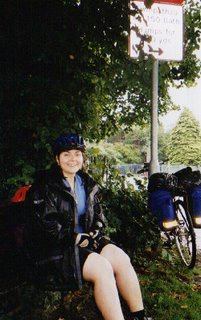
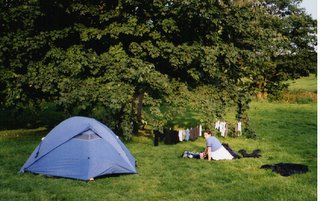
The rain here has a sporadic quality that both baffles and delights. Delights because it is cooling and casts a magical veil over wood and farm, baffling because it seems to rain only until one is prepared for rain, then ceases to be.
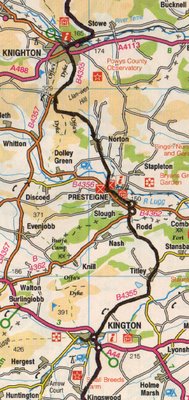
Our plans for the rest of the journey are ever changing. I had chosen a path because of convenience and the possibility of exposure to many antiquities but not through any heartfelt attachment. I was misunderstood and the path was assumed to be set in stone. But we have rectified that and have chosen a, hopefully, better route.


Next Entry: Day 14
Previous Entry: Day 12