Showing posts with label Christianity. Show all posts

Sunday, November 13, 2011

Day 99. Avignon. Nov 13 2001

On the bridge of Avignon
On y danse, tous en rond

We awoke early, the Mistral driving us from our bed, and we crossed the short walk into the old walled town of Avignon. The walls were intact, their crenellated barrier separating old Avignon from the progress of time. Great towers peered out, ancient sentries whose old foes had disappeared long ago, remembered only as names in books, if even that. The walls were a mythical barrier and crossing them transported us through time to an era of grandeur and strife. An era when the Popes were not safe, even in Rome, when crossing a river was a phenomenal challenge.

We made our way through a labyrinth of streets to the grey shell of the Popes Palace, a windswept square before it. We entered the Hall of Dignitaries beneath two turrets. The ancient entrance was closed, the wood and iron bands decaying and rays of light piercing through.


Avignon had become the Papal residence when Clement V grew weary of wandering about Europe but was too afraid to settle in Rome. In 1309, the year of his arrival, Avignon was part of the Papal States, a separate entity from the Kingdom of France across the Rhone River. The location was also better for the spiritual Lords of Europe, at a crossroads between France, Spain and Italy, the strongest nations in Christendom. But from the moment of their arrival the Popes began efforts to return to Rome. The histories say that without the aura of power cast by the Eternal City the Popes were worried about their legitimacy but I think it had more to do with a desire to escape the Mistral.

The Courtyard of Honor was a paved square between the old palace, built at the command of Benedict XII, and the newer palace of Clement VI. It was a cold grey ugliness between cold grey and ugly walls. We hurried along the tour to the Treasury Hall. The Upper Treasury Hall, where the Pope's accountants would keep their record books, was full of displays. The coins of the realm, models of the Palace, the faces of the Popes. Of particular interest was the small display consisting of all the things that people would throw at the Popes while they were in residence in Avignon. From rocks, to catapult ammunition, spears and ballista bolts. The exhibit of the skull and the corresponding spear that was removed when the body was exhumed speaks volumes about the nature of theological disputes.

But it was the empty Lower Treasury that really caught our attention. A lager square stone chamber, only poorly lit, with uneven rock tiled floor. It was not very imposing. One could imagine racks of papal treasure here, walls dripping with gold and jewels. But it was under the floors where the real action was. The floor of the treasury was a disguise. It looked perfectly solid. Rock slabs resting against the rocks of the hills you could see outside. But underneath rectangular slabs a foot thick was the Pope's secret hoards of money. Without the audio guide and the slabs pried up in demonstration there would have been no way to know.

Above the treasuries was the Jesus Hall, an unimpressive room so named because of the X symbols on the wall.

From here we walked to the Consistory Hall, a long chamber filled with the relics of destroyed paintings. Paintings that had been slashed, punctured or beaten or that had merely rotted away with age in an unexplained display of artistic carnage.

We hurried into the upper cloister, then up a flight of stairs to the Grand Tinel. The Grand Tinel was the great dining hall of the Popes, a vast hall that echoed now to the footsteps of tourists. Here Popes and Cardinals and royal guests had dined beneath colorful tapestries. Strict etiquette applied and the Pope tested every meal with the liberal application of unicorn horns and sharks teeth to magically detect poisons. He also sat alone on a high dais overlooking the assembled faithful. It must be lonely to be Pope.

Here, in a bricked over arch hidden in one corner of the room, was the entrance to the Conclave. At the death of every Pope the wall was smashed in and the College of Cardinals sequestered behind iron bars, fed like prisoners through an iron grate in the wall until they decided on the
new Pope. Great incentive to choose quickly.

Behind the Grand Tinel was the tour of the kitchen. Instead of a fireplace the tower narrowed at the centre to a small aperture. Food was roasted on a great fire in the centre of the room, burning the flagstones on the floor.

Fire devastated the Palace of the Popes in 1431.

We descended into a bleak undecorated square of cold stone, the Chapelle Saint Martial. It is here that the Popes announced at Easter who was to be the recipient of the Golden Rose, a rose in solid gold with a sapphire gem. The recipient was to be the greatest Christian that year had produced. Here too he announced the recipient of the sword, belt and hat at Christmas, an even greater honor. But the glory left with the Popes. Now the room is merely dark and cold.

Finally we entered the Popes chamber, a dark blue room overgrown with intertwining vines and colonized by birds and squirrels, all in the paintings that decorate every wall. The Popes, it appears, loved captive birds, so much so that they painted their walls with them. The room is darkly beautiful. As beautiful as the Popes bedroom is, so too is the next one strange, the Stag Room. A large room decorated with the purely secular themes of the woodland hunt. Streams pour from the walls while trees reach for the ceiling. Men chase deer and haul fish from a pond while children cavort through the wilds. In one corner a pair of rabbits mates.

We exited to the Popes Balcony on which he could stand and bestow his blessings to the privileged few who filled the Courtyard of Honour on festival days. To our left was the Tour De La Gauche and we climbed it to the rooftops. Here the Papal guards mounted their watch each night, more to detect fires in the city than to discover the enemies that might be sneaking up to attack Avignon. The Mistral howled amidst the gothic sculptures and leering gargoyles. We fought our way to the terrace to peer down on the city but the wind ripped at us as we peered between the crenelations.


We returned to the Popes balcony and descend the Staircase of Honor to the great audience hall. A room as long as the great chapel, vaulted ceilings of bare rock. In one vault in the far corner the remains of a frescoe by Matteo Giovanni, painter to the Pope. The Palace of the Popes has been like great skeletal remains, abandoned by its mother church. Great events transpired here but when the Popes left they took with them the heart and soul of these buildings. All that remains is the dead bones, the calcified arteries and veins and organs of a colossal giant. But it is empty and it is cold.

We climbed to the neigbouring Cathedral Notre Dame des Doms. A glittering golden Mary, crowned by a halo of stars, looked down on us from her heights. The wind howled past her with blasphemous demonic fury. A couple was lost in each other charms beneath the Cathedral's cross and a poor man begged in the doorway beneath the riches. Life rolls ever on.


The church was magnificent, a dark grotto on a windy day. Dark niches line the walls, a faint beam of light descends from above on the altar, a crimson Bishops Chair is recessed into the wall, looking at the Popes Door from which the Popes emerged.

The statues of saints and holy figures are more sumptuous here than anywhere else, their vestments gleam in yellow light, bronze or gold I don’t know, but it is obvious that the Papal presence elevated this place above many others.

There is a concession shop next to the church, glass doors opening onto the sanctuary. There are faithful here but there are more tourists, who dig out money to buy pictures or chocolate bars. I cannot help but wonder what the Christ who overturned the stalls of the money changers in the temple would made of this new permutation of capitalism.


Next Entry:Day 99. Avignon Continued
Previous Entry: Day 98. Avignon

Wednesday, October 05, 2011

Day 60. Le Mont St. Michel. Oct 5 2001.

We arrived today with tide still in and what a difference it made. From a rock, albeit a beautiful rock, sitting in gray mud, The Mont was transformed into an island floating on a sea of blue. The parking lots of yesterday had disappeared beneath the waves and the Mont was connected to the land only by a narrow ribbon of rock and concrete. But even as we watched the tide receded and special trucks rolled out to wash the silt off the parking lots and another day began at Mont St. Michel. We walked up the thousand steps to the abbey, then a hundred more to the entrance and we took our place among the waiting throng. I will share our tour.

We began in the Hall of the Guards, the abbey's fortified entrance. Here, in times past, the knights of Mont St. Michel would guard against attack or officials of the government would greet new prisoners and now a young lady checks your ticket. From the hall we climbed a hundred stairs more, along the Staircase of the Great Degree, the access way to the church of the abbey. On our left rose the great walls of the abbey's lodgings, on our right, the walls of the lower churches buried beneath the great church. On either side the walls rose so high that all that remained was a thin slice of blue sky above. Sometimes even that disappeared under the fortified bridges through which the monks traveled between church and bed. Finally we rose out of the depths to the Terrace of the West.

The terrace granted pilgrims a panoramic view of the bay and the seething town on the slopes below.

  It was wide and flat and it was here the official tour began. With our small tour, numbering only in the low hundreds, we entered the abbey of Mont St. Michel.


Like most other Christian churches in Western Europe it was in the shape of a cross. The nave was done in Romanesque architecture with thick pillars supporting soaring barrel vaults. It was in three layers, the first the barrel vaults, the second, perhaps thirty feet above ground level was made of tiny arches and the third was stained glass windows. The choir, or head, of the church had been redone in a flamboyant gothic style with pointy arches inside and flying buttresses outside. At the top you could see the flame shaped carvings from which the flamboyant style took its name. The choir had been rebuilt when it had collapsed in the 15th century. The entire abbey, except for the exact middle, was supported on smaller churches built up on the island. The center was the only portion supported by rock. The abbey was vast, but virtually devoid of decoration.


In the center was a carving of St. Michel in his third aspect, the warrior angel, charged with fighting the forces of Lucifer wherever they may be found. Satan was expressed in the shape of a dragon, hence the gilded statue at the pinnacle of the church, of St. Michel slaying the dragon. Too bad, I like dragons.

From the abbey we were led to a piece of heaven on earth, the cloisters of the monks. The cloisters were square, as all cloisters are, with a double row of columns separating the walk from the open aired garden in the center. Here the monks came to meditate on the chapter of the bible they had read that day. There were 137 columns, 1 for the only god, 3 for the trinity, 7 for the perfect number. The columns were designed to set a pace for the monks as they wandered in contemplation. Each column on the inside row came down exactly in the middle of the arch made by the two columns on the outside row, one pace forward.

The arches between columns are covered in sculptures depicting plants that would normally be found in a cloister. Hidden among the stone plants are fiendish monsters to remind the monks that evil lurks everywhere. Unfortunately the sculptures often depicted evil as being extremely cute so I’m not sure it had the intended effect.

Cloisters are supposed to be enclosed structures with no view of the outside world to distract from mediation but here a door opened out to a view of the bay, a least a couple hundred feet above sea level and over a hundred in a sheer drop. The monks had opened it as the beginning of a project to build a chapter house and run out of funds. Only recently had a pane been put in to protect people from the drop, perhaps the monks had kept in open to escape from meditation.

Most cloisters have a garden in the center. In the 1960’s it dawned on someone that this one did not, so they rectified the situation by adding one. But the monks weren’t stupid. Below the cloisters is the scriptorium where they copied books and a garden overhead means water below so now they are in the opening phase of removing the garden, after it wrecked the plaster of the scriptorium.

From the cloisters we moved into the refectory where the monks had eaten their meals. A vast silent room, except when filled to the brim with a tour, at which point it became impossible to hear anything for the never-ending echoes. Here the monks would eat bathed in light that swam in from cunningly concealed windows and filled the room.

Our tour guide next raced past the Salles des Hotes (because that was were the tour was supposed to end) and took us down a never ending flight of stairs and around the back of the central peak of the Mont, concealed behind a wall of thick bricks. Eventually we emerged into a small chapel were the only remaining fragment of medieval fresco on the Mont was hung. The chapel stood between the infirmary and the ossuary, the place of bones, to remind the monks that they were still mortal. The fresco depicted three dead people reminding their living selves that death always lurked. Cheerful thing to have in an infirmary.

From the chapel we went to the Room of the Giant Hamster Wheel.

The Room of the Hamster Wheel was actually the ancient ossuary where the bones of dead monks had been stored. But the French revolution has seen those destroyed and the authorities of the prison had transformed the room to a supply room. Here the supplies were hoisted up a long steep ramp on sleds pulled by prisoners running in the hamster wheel. Strangely enough the monks had used a similar system on the north side of the Mont, which the revolutionaries had destroyed, only to find they had no way of getting food.

From there we went to another chapel, this one acting as a support for the south transept of the church. It was in almost complete darkness because the prison had used it as a cistern and all the windows had been walled up to keep the water in.

Next came The Crypt of the Big Pillars and unlike the room of Giant Hamster Wheel, I am not making this name up. This crypt has stored no dead and served no religious functions. Instead it housed enormous pillars that supported the choir of the church. Each pillar was a gothic pillar, completely enclosing the Romanesque pillar that had existed previously. In a small corner of this crypt was a gilded golden statue of the Madonna and child atop a globe blue with silver stars. A sister church in Spain had given it to encourage the reconstruction effort. Nice place to store such a gift!

Finally the tour led us back to the Salle des Hotes and the Salle des Chevaliers, with a stop in the scriptorium. The scriptorium was an enormous room where the monks had copied manuscripts all day long. To give them consistent light the only windows were to the north and these were small round circles that looked out like portals from a vast ship. You could see the decay in the plaster from the garden overhead.

The Salle Des Hotes was the chamber where the nobility had been entertained and had once been richly decorated in the blue and stars of the French Crown, but was again destroyed during the French revolution. Finally the Salle des Chevaliers, where the knights would sleep, and the end of the tour.

Here everyone filled passively down the narrow stairs though the guide had invited everyone to stay and explore on their own. We were the only ones to stay. Now we discovered the Mont’s greatest secret. The tours come in waves and everyone, everyone, stays with their tour. In the troughs between the waves the Mont is completely deserted. Imagine all the rooms I have described, filled with a hundred, two hundred, people, then going back and finding them completely empty.

We were like two kids in a candy store. We ran from room to room with delight. We retraced the entire tour and saw everything with no distracting presence. Heather especially loved the cloisters and we spent a lot of time there.

Eventually we found our way back to the abbey and discovered a staircase down to another chapel and here a community of monks and nuns were having mass. We stayed for the service and it seemed to place the whole structure into context. Though we might not necessarily agree with the message expounded in the mass, it was a very beautiful ceremony and it brought home who the monument should really belong too. It seemed strange that with this massive religious edifice all around us the monks and nuns should be shunted off to some deep grotto so as not to offend the eye or to interrupt the tour. They are the soul of the Mont and without them it is merely the dead remains of a once living body. We left feeling better for having seen the service and having participated in our own little way.

Finally we descended the innumerable steps of the exit

and emerged in an enormous gift shop near the entrance. It seems that humanity will never tire of buying tacky objects. Though what we would do with a tin of cookies shaped like the Mont, except eat them, escapes me.

We then circled the Mont to visit the tiny chapel at the rear.


It had been a long and beautiful day and as we biked back the 12 kilometers to our campground we were very happy.

Next Entry: Sens De Bretagne
Previous Entry: Day 59. Le Mont St. Michel

Monday, August 22, 2011

Day 16 August 22 2001


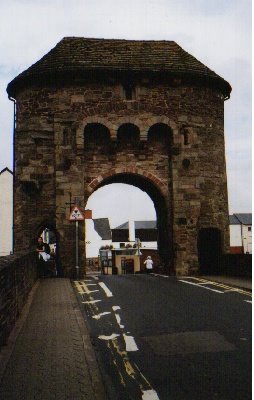
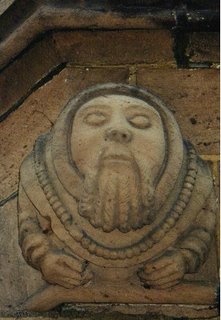
A day of rest and of pure tourism. We walked about town, a bit frustrated to discover that before 2 pm none of the monuments were open. But we finally entered the church of St. Mary’s and what a delight. A church of antiquity, that remembered and reveled in its past yet shared its use with the present. Everywhere was intricate ironwork that captured the living essence of flowers and growing things. The stained glass brightly proclaimed the stories of the church and the men of faith that Monmouth had given to the world.
It was strange to amble from that monument, that prayer in art, to a deification of another sort. The Nelson museum proclaimed the divine elevation of the state and the apotheosis of Horatio Nelson. Here the memory of Admiral Nelson is preserved, decorated, gilded until he and his devotion to the empire are memorialized in a vomiting of platitudes. It was almost a relief to leave.

From there to the castle and regimental museum. Here was a more dignified memorial of wars. Yes, they are to be remembered, but for what they are, not a glorified image. Here they demonstrated what the common people think of political intrigues that tear their land apart. I especially enjoyed the pride with which the people of Monmouth declared that during the British Civil War they were always ready to serve whichever side had most recently conquered it so, long as they were left mostly alone.
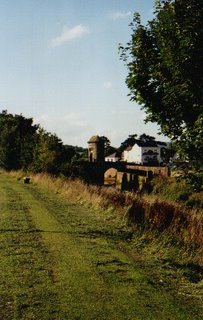
From there we bought food and ambled down the banks of the Monnow River and talked at length on the nature of art and the ability of people to appreciate it. And we read and talked of the nature of religion and the meaning of the Gnostic gospels. Such discussions they were that I hesitate to write them down for knowledge that I will run short of space. And I must admit that discussions is a gentle title for what amounted to me rambling on and Heather politely listening and asking questions when it was obvious that I wanted her too.
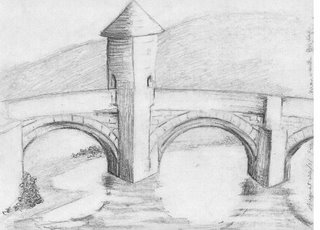
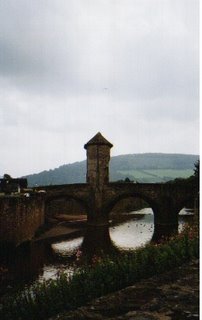
Tonight we look forward once more to our tent and I must admit that I tired of our portable accommodation. Cramped, hot, stale, bug infested and altogether disheartening are words that describe our wedding bed.

Next Entry: Day 17
Previous Entry: Day 15

Sunday, August 21, 2011

Day 15. Monmouth. August 21 2001

What hell to get here.

We left Vowchurch, the site of last nights campground, in pain already. We aren't used to sleeping out of doors and sleeping on the ground has left us with every muscle aching.

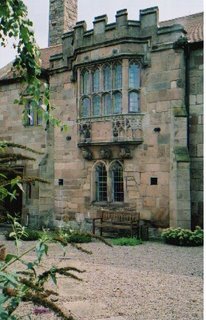
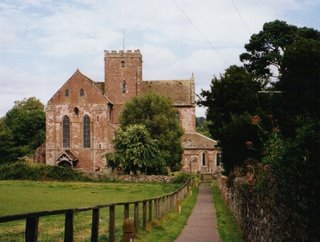
By the time we reach the town of Abbey Dore we are in desperate need of a rest. Here we make a striking and beautiful discovery. The abbey is an amazing building, all that remains of a once vast and proud monastery that dominated the golden valley.

As we walk through it a great melancholy sweeps over me. I mourn for the lost monks and ghosts of beauty left behind. The abbey was once a pulsing vital place filled with people of strong belief and a certainty of the shape of the universe. Now it is a shell filled with meaningless material tokens and a small congregation struggling to maintain remembered greatness. They can't even raise the funds to fix the roof.


We left there to continue down the valley. An alternate reason for its golden name sprang to mind as we passed many large and wealthy estates.

The trip was by no means an easy once. Heather had gotten no rest out of our brief stop and her condition deteriorated rapidly as we cycled. By the time we were halfway to Monmouth she was more than ready to quit and very vocal about her state of mind. Unfortunately the nearest campground was in Monmouth.

We trekked on and before long my muscles too began to feel the strain. Additionally I was having a terrible allergic reaction to the countryside. The dead still air of the abbey irritated my nose while the constantly rushing air left my eyes burning and itching. Even medication did not fully alleviate my problems. Every hill became an agony and the joy of every descent was stolen by the ever present wind that seemed to rob us of our speed. In the days before we learned the meaning of long slow hills, of rain and struggle. Today we learned the meaning of small steep hills that never ended. We learned too the agony of muscles overused and nearing their limits. By the time we drifted into town it was decided that tomorrow would most definitely be a day of rest.

Next Entry: Day 16
Previous Entry: Day 14

Saturday, August 20, 2011

Day 14 August 20 2001

Two weeks.
Exhaustion, exhilaration, delight, anger and frustration. What a mixed bag today has been.

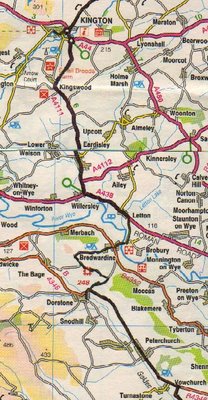
Off from Kington, in the general direction of a small town called Bredwardine. Today began, as every day has so far, with a large hill. This one was not as large as those we confronted on other days but both Heather and I started off exhausted and sore.

I don’t think Heather has noticed yet but she is already doing better even in an exhausted state.

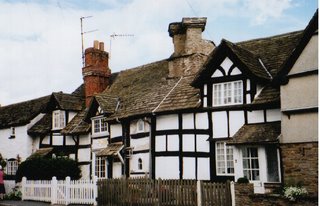
After the hill it was downhill to a marvelous town called Eardisley. Every building in the town was tilted northwards as though pointing the way out of the Wye valley.
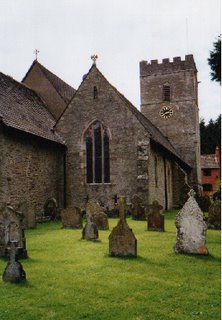
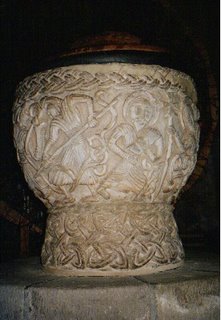
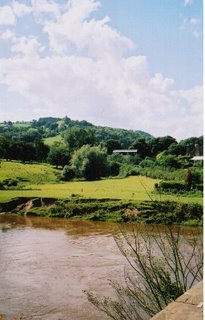
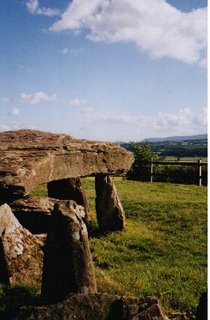
The church at in town, the Church of Mary Magdalene was a magical place. The tombs and gravestones were weathered with eons of decay and inside was the most spectacular baptismal font adorned with the eternal conflict between good and evil. After a brief lunch we trekked on and soon crossed the Wye River. We stopped on the bridge for a moment to watch a group of teenage boys, egged on by the presence of a rather bored looking girl, leaping off a bridge into the murky water of the Wye. Then we confidently biked on, again towards the town of Bredwardine. a campsite and the ancient site of Arthur’s Stone. Undaunted by the 25% grade we gamely trudge uphill even after being barked at by various dogs and after being when told that no campground existed. After an hour of climbing gamefulness changed to frustration and disappointment. We climbed for what seemed like forever only to find that we couldn't even find Arthur’s stone. In despair, and with no where else to go, we marched on. We soon gave up all hope, at which point we ran into…Arthur’s stone. We were, however, still disappointed to learn that it was only a Neolithic burial chamber with no connection to the king of legend.
From the Stone we plummeted down the other side of our hill to find ourselves in the Golden Valley. It was a nice ride and easy to see where the name might have come from. The hay and the wheat in the sun truly did transform the valley floor to gold.
From the heights we had seen the Black Mountains from afar and it seemed like we could touch the clouds. It was beautiful. Here in the Valley, cut off from such beauty and surrounded by the more mundane, it is much easier to pedal. There are, it seems, trade offs for everything.


Next Entry: Day 15. Monmouth
Previous Entry: Day 13